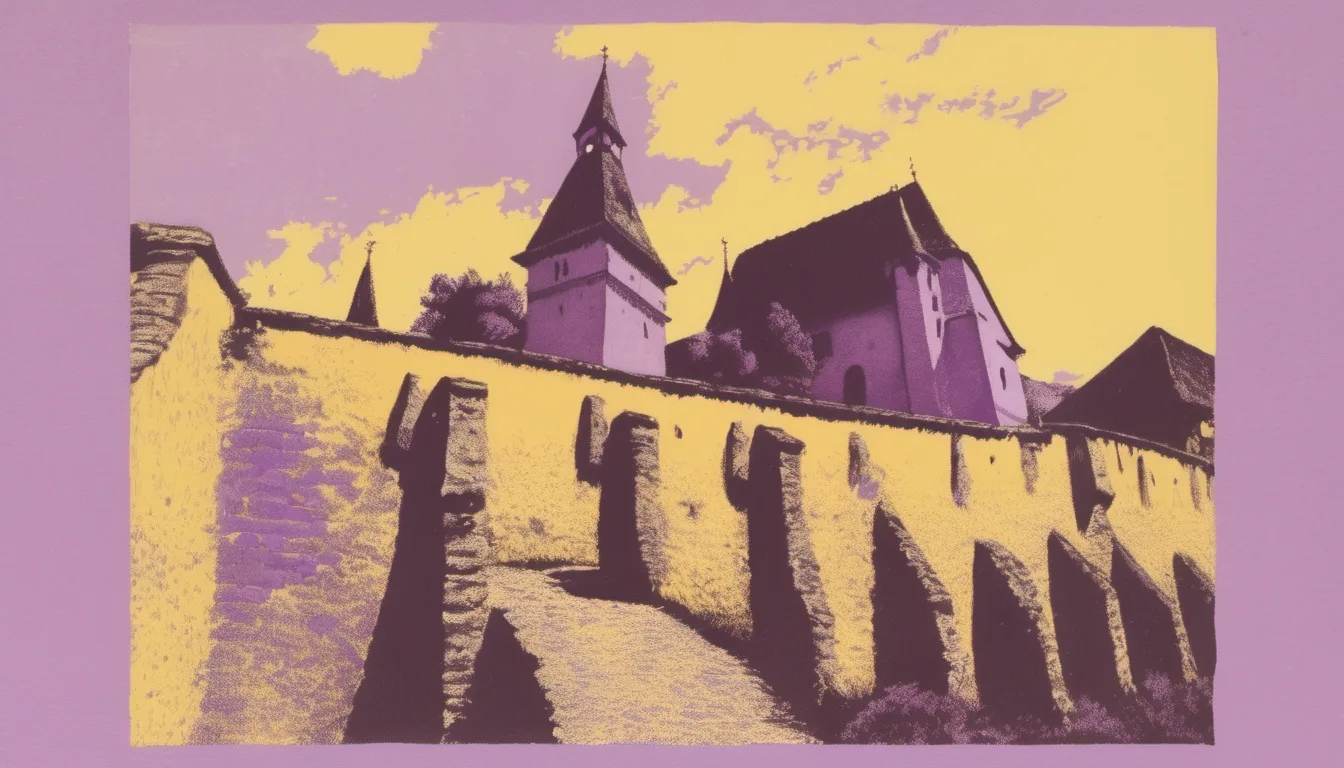
Biertan, Romania
Biertan does not announce itself. It waits on the Transylvanian Plateau, 388 meters above sea level, where the rivers Biertan and Vale carve a quiet path through the hills. This is not a place of grand gestures, but of enduring stone. For centuries, Transylvanian Saxons built here, creating a settlement that grew into a market town of five thousand souls by the early sixteenth century. Today, the population is smaller, but the presence is heavier. The air here feels older, thick with the memory of those who came before, those who left for Germany, and those who stayed to tend the vines and the corn.
At the center of this quietude stands the fortified church, a UNESCO World Heritage site since 1993. It is not merely a place of worship; it is a citadel. To reach it, you must climb the impressive wooden staircase, built in 1795, rising in seven steps for roughly one hundred meters. This ascent is a ritual in itself. It separates the mundane world below from the sacred and defensive world above. At the top, near the church, a large stone waits, historically used to bind those who committed minor offenses, ensuring they were seen by the entire community during Sunday mass. It is a stark reminder of a society where visibility and shame were tools of order.
The church itself, constructed between 1492 and 1516 in late Gothic style, is dedicated to Saint Mary. It possesses three entrances, a practical design for priests, elders, and special occasions. But the true marvel lies within. The pulpit, carved in 1523 by Ulrich of Brașov, is a masterpiece of stone and wood, depicting New Testament scenes with architectural and botanical precision. The choir stalls, made between 1514 and 1523 by Johannes Reichmuth of Sighișoara, are among the most precious in Transylvania. They are not just furniture; they are a testament to a community that valued artistry even in times of threat.
Walking Biertan is an exercise in looking closely. The fortifications spiral up the hill in three concentric circles, six towers, and three bastions, built between the fourteenth and sixteenth centuries. Each tower has a name and a purpose: the Clock Tower of 1508, the Mausoleum Tower, the Prison Bastion. The latter holds a legend of a couple locked inside with a single bed, a single plate, and a single set of cutlery until they reconciled. Only one couple failed to make peace. This is the singular nature of Biertan. It is a place where theology, defense, and daily life were woven into a single, complex fabric. You walk here not to see a monument, but to understand how people lived, fought, and prayed in a land of shifting borders and faiths.
To understand Biertan, one must first understand the silence. It is not an empty silence, but a dense one, layered with centuries of Transylvanian history. Situated on the banks of the rivers Biertan and Vale, at an altitude of 388 meters, the commune sits in north Sibiu County, Romania. It is a place defined by its defensive posture, a response to the turbulent history of the region. The village is believed to have been founded between 1224 and 1283 by Transylvanian Saxons, who quickly developed it into an important market town. By 1510, it supported a population of about 5,000 people, a significant number for the era. The Saxons, a Germanic minority, brought with them the architectural and religious traditions of Central Europe, adapting them to the rugged terrain of the Transylvanian Plateau.
The history of Biertan is inextricably linked to the concept of the fortified church, or Kirchenburg. Between 1468 and the sixteenth century, a small fortified church was constructed and developed. This was not merely a place of worship; it was a refuge. In a region often caught between Ottoman incursions and internal strife, the church became the center of community life. The Biertan fortified church is one of the most important of these structures, having been on the list of UNESCO World Heritage Sites since 1993. It is the best-preserved and most significant example in Transylvania, a testament to the ingenuity and resilience of its builders.
The ascent to the church is a defining experience. You approach from the village, following the path to the base of the hill. Here stands the impressive wooden staircase, built in 1795. It rises in a series of seven steps for approximately 100 meters. This is not a gentle slope; it is a deliberate climb, designed to slow you down and prepare you for the sacred space above. At the top, near the church, a large stone block sits on the ground. Historically, this was where individuals who had committed minor offenses during the week were bound. They were displayed to the entire community during Sunday mass, a public act of shaming that reinforced social cohesion. It is a stark, almost brutal reminder of the moral order that governed this community.
The church itself, constructed between 1492 and 1516 in late Gothic style, is dedicated to Saint Mary. It features three entrances: west, south, and north. The latter two were reserved for priests, their families, elders, and special occasions. The main western portal, also late Gothic, is surmounted by the coats of arms of Ladislaus II and John Zápolya. Inside, the three majestic nave aisles are vaulted in a net pattern. The space is vast, echoing with the footsteps of centuries. But it is the details that hold your attention, the craftsmanship that speaks of a community that valued beauty even in the face of danger.
The pulpit, carved in 1523 by the master stonemason Ulrich of Brașov, is a masterpiece. It depicts scenes from the New Testament, rendered with detailed architectural and botanical elements. The polychrome wood lining dates from 1754, adding a layer of color to the stone. The choir stalls, created between 1514 and 1523 by Johannes Reichmuth of Sighișoara, are among the most precious in Transylvania. They are not just seats; they are works of art, reflecting the high level of skill present in the region. Reichmuth also designed the sacristy door in 1515, a masterpiece of wood inlay with a unique locking system that activates four mechanisms and thirteen bolts. This door was exhibited and awarded at the 1900 Universal Exhibition in Paris, a recognition of its technical and artistic excellence.
The sacristy served as a strongbox, housing chalices, paintings, and other precious objects. On the altar stands a large polyptych with 28 panels, created in several phases between 1515 and 1524 by local masters influenced by those from Vienna and Nuremberg. The scenes depict the life of the Madonna, and at the center, a Crucifixion with the Virgin and Mary Magdalene embracing the cross. This image was placed after the Reformation, replacing a Madonna and Child, reflecting the theological shifts of the era. The organ, built in 1869 with 1,290 pipes, completes the auditory landscape of the church, its sound filling the vaulted space.
The defensive system of Biertan is as complex as its interior. It consists of three concentric walls, six towers, and three bastions, built in different periods between the fourteenth and sixteenth centuries. The walls spiral up the hill, creating a layered defense. The first circle, the lowest, has two towers and a watchtower bastion, now converted for tourist entry. The southern tower, the lower gate tower, allowed entry to the wall circle. To the west, the Weavers' Bastion now serves as the studio and exhibition space for a local painter, a modern use for an ancient structure.
The second circle, with walls seven to eight meters high, enclosed two inner courtyards where the community could bring their animals in times of danger. Access is via a south ramp from the so-called Lard Tower, named because lard and food were stored here during sieges. In the middle of the western wall, corresponding to the carriage gate connecting the lower and middle sections, stands the Town Hall Tower, which hosted city council meetings. Remnants of decorations are visible just under the roof, hinting at a past opulence. The third wall, the upper and oldest, has four towers and a bastion, plus the Town Hall Tower, shared with the other walls.
The Clock Tower, built in 1508 to the north, functioned not only as a clock with two bells but also as a defensive tower, equipped with walkways and loopholes. The bell tower, entirely wooden, was restored in the early nineteenth century. To the northeast, the Mausoleum Tower houses the tombstones of the bishops of the Diocese of Biertan and some priests, moved there in 1913. The slabs were made by Nikolaus Elias of Sibiu. To the east, the Prison Bastion holds a famous legend: couples seeking divorce were locked inside with a single bed, a single plate, and a single set of cutlery. They were fed only bread and water until they reconciled. Legend says the system worked, except for one couple who failed to make peace.
To the south stands the Catholic Tower, a symbol of religious tolerance in a land often marked by ethnic and religious conflict. When most of Biertan became Protestant, this tower was erected for Catholic faithful. Since 1564, Transylvania was the only European country with at least four confessions: Calvinist, Lutheran, Antitrinitarian, Roman Catholic, and Orthodox. This degree of religious freedom was rare. The tower contains a chapel with frescoes depicting Byzantine-style scenes of the Last Judgment. This architectural diversity reflects the complex identity of Biertan, a place where multiple faiths coexisted, sometimes uneasily, within the same walls.
The commune of Biertan includes three villages: Biertan, Copșa Mare, and Richiș, each with its own fortified church. The route of the Via Transilvanica long-distance trail passes through all three. The Biertan Donarium, discovered in 1775 in a forest about 5 km away, is a bronze labarum from the fourth century, inscribed with 'EGO ZENOVIUS VOTUM POSVI'. It proves the existence of a Latin-speaking Christian population in Dacia after the Roman withdrawal in 275 AD. Today, Biertan is one of the most visited villages in Transylvania, hosting the annual reunion of Transylvanian Saxons, many of whom now live in Germany. It is a place of memory, stone, and quiet endurance.