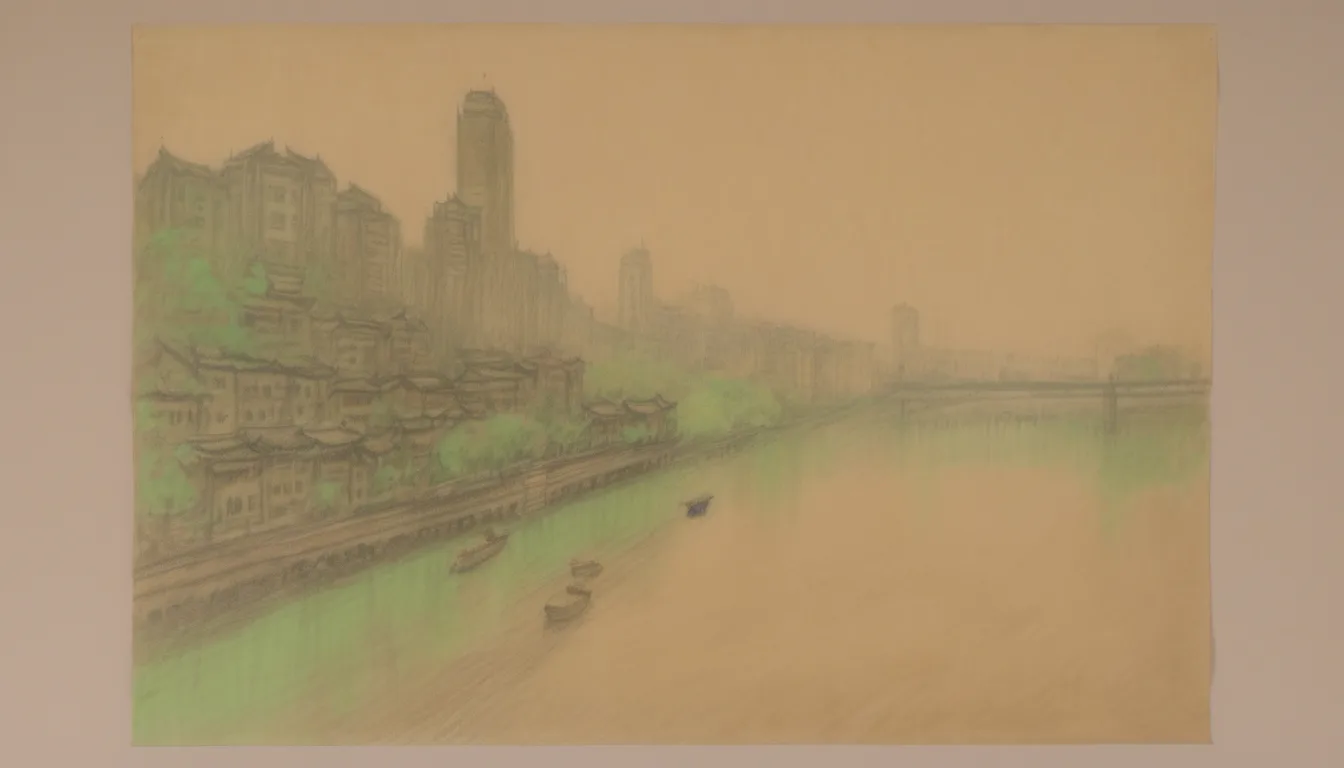
Chongqing, China
Chongqing does not sit on a plain; it climbs. Perched on the banks of the Yangtze and Jialing rivers, this provincial-level municipality is a study in verticality. It is not merely a city but a vast administrative entity, larger than Austria, containing urban islands scattered across rugged terrain. To walk here is to navigate a three-dimensional grid where streets exist on rooftops and basements alike. The geography dictates the rhythm: steep inclines replace flat avenues, and the air carries the weight of coal smoke and river mist.
The city’s significance is rooted in its resilience. During the Second Sino-Japanese War, Chongqing served as the provisional capital of the Republic of China. From 1938 to 1943, it endured relentless bombing campaigns, yet its people persisted, earning the title 'City of Heroes.' This indomitable spirit shaped the urban landscape, with air-raid shelters carved into the mountainside still visible today. The war transformed an inland port into a heavily industrialized hub, a legacy that persists in the city’s dense, layered architecture.
Walking through Chongqing rewards those who look up and down as much as ahead. The Chaotianmen Bridge, with its record-breaking steel arch, connects the converging rivers, while the monorail system, the world’s longest and busiest, snakes through the hills. You will encounter the Great Hall of the People, a circular structure in the Tang style, and the bustling chaos of Foreigners’ Street, home to the Palace of Porcelain. The city is a paradox of ancient Ba kingdom roots and hyper-modern infrastructure.
Today, Chongqing stands as a National Central City, a key node in the Belt and Road Initiative. It hosts foreign representations, major universities, and the headquarters of Changan Automobile. Yet, beneath the concrete and steel, the city retains a distinct character. The thick fog that once protected it from bombers now shrouds its skyscrapers. To walk here is to experience a city that has reinvented itself repeatedly, from the Warring States Period to the modern era, always adapting to the mountains that define it.
To understand Chongqing, one must first abandon the concept of a flat horizon. This municipality, one of four direct-administered by the central government in China, is an anomaly in its scale and topography. Covering an area roughly the size of Austria, it contains 26 districts, eight counties, and four autonomous counties. The urban core alone houses over 23 million people, making it the largest city proper by population in the world. Yet, this density is not spread across a grid but layered over a complex geological canvas of hills, rivers, and valleys. The Yangtze and Jialing rivers converge here, carving through the stone and dictating the flow of history, commerce, and life.
The roots of Chongqing stretch back to the semi-mitological Kingdom of Ba, founded in the 11th century BC. By the Warring States Period, it served as a gateway to the western border of the State of Chu. In 277 BC, Zhang Ruo, governor of Qin Shu, captured Wu Commandery, establishing Qianzhong Commandery. The area was later named Jiangzhou by Qin general Zhang Yi. The name 'Yu' survives today as an abbreviation for Chongqing and in the historic Yuzhong district. In 581 AD, during the Sui Dynasty, it became Yu Prefecture. It was renamed Gong Prefecture in 1102, but the pivotal moment came in 1189. Prince Zhao Dun, upon his enthronement as Emperor Guangzong, declared a 'double celebration' (chongqing), renaming the city accordingly. This etymology anchors the city’s identity in a moment of imperial joy and political transition.
The imperial era saw Chongqing as a stage for rebellion and brief kingdoms. In 1362, Ming Yuzhen, a peasant rebel, established the Daxia Kingdom here. In 1621, She Chongming founded the short-lived Daliang Kingdom. The fall of the Ming Dynasty in 1644 brought chaos; Zhang Xianzhong captured Sichuan, causing mass depopulation through violence and flight. The subsequent Qing Dynasty encouraged immigration to repopulate the region. This history of upheaval and reconstruction is etched into the city’s layered urban fabric, where old towns nestle against new developments.
The late 19th century marked Chongqing’s opening to the world. In 1890, the British Consulate General opened, and the city became the first inland commerce port open to foreigners. A restriction prevented foreign ships from trading until Chinese steamers ascended the Yangtze, a barrier abolished by the Treaty of Shimonoseki in 1895. By 1907, steamships made the journey without manual haulers. Consulates from America, Germany, France, and Japan followed, transforming Chongqing into an international hub. This era laid the groundwork for its role as a critical node in the Yangtze River Economic Belt.
The city’s modern identity was forged in fire during the Second Sino-Japanese War. From November 1937 to May 1946, Chongqing served as the provisional capital of the Republic of China under Generalissimo Chiang Kai-shek. Formally declared the second capital (peidu) in 1940, it became a target for continuous bombing by the Imperial Japanese Navy and Army Air Forces. The city suffered immensely, yet its people endured. Air-raid shelters, carved into the mountainous terrain, saved countless lives. The city was acclaimed the 'City of Heroes' for its indomitable spirit. Factories and universities relocated from eastern China, transforming Chongqing from a port to an industrial powerhouse.
Key figures of the Allied war effort operated from here. Joseph Stilwell, deputy commander of SEAC, and Lord Louis Mountbatten, Supreme Commander of SEAC, worked closely with Chiang Kai-shek. The thick fog that shrouds Chongqing today once provided natural camouflage against aerial bombardment. This period of sacrifice and industrialization left a lasting mark, with many wartime structures and memories preserved in museums and the urban landscape. The city’s resilience during these years is a central pillar of its local identity.
Following World War II, Chongqing remained a refuge for the Nationalist Kuomintang government during the Chinese Civil War. After the fall of Nanjing in April 1949, the KMT retreated to Chongqing, serving as their capital until late November 1949, when they withdrew by air. The city’s political significance continued into the modern era. On March 14, 1997, the Eighth National People’s Congress granted Chongqing independence from Sichuan, merging it with Fuling, Wanxian, and Qianjiang. This created the current municipality, aimed at developing Western China and managing resettlement from the Three Gorges Dam area.
Today, Chongqing is a National Central City, one of nine in China, complementing coastal hubs. It serves as a base for the Belt and Road Initiative and a connection in the Yangtze River Economic Belt. Infrastructure defines the modern experience. The monorail system, the world’s longest and busiest, features 70 stations. The Chaotianmen Bridge, inaugurated in 2009, holds the record for the longest steel arch span. High-speed rail stations, including the massive Chongqing West, connect the city to the rest of the nation. The city hosts 12 foreign representations, the fifth-most in China, and is a top global city for scientific research output.
Walking through Chongqing reveals its architectural and cultural landmarks. The Great Hall of the People, a circular building in the Tang Dynasty style, dominates the central district. The headquarters of General Joseph Stilwell now houses a museum, preserving the wartime legacy. The city’s modern zoo features giant pandas and South China tigers, while the rare Chongqing dog bears the city’s name. Foreigners’ Street hosts the Palace of Porcelain, an impressive complex of public restrooms. These sites reflect a city that balances historical reverence with modern utility.
The city’s geography presents unique challenges and rewards. Steep hills reduce the use of bicycles, making walking and the extensive bus network essential. The semi-tropical climate, influenced by monsoons, brings heavy fog, which, while historically protective, contributes to air pollution due to coal usage. Yet, this environment creates a singular atmosphere. The interplay of river, mountain, and fog shapes a city that is both industrial and poetic. To walk here is to navigate a vertical labyrinth, where every ascent offers a new perspective on a city that has continually reinvented itself.