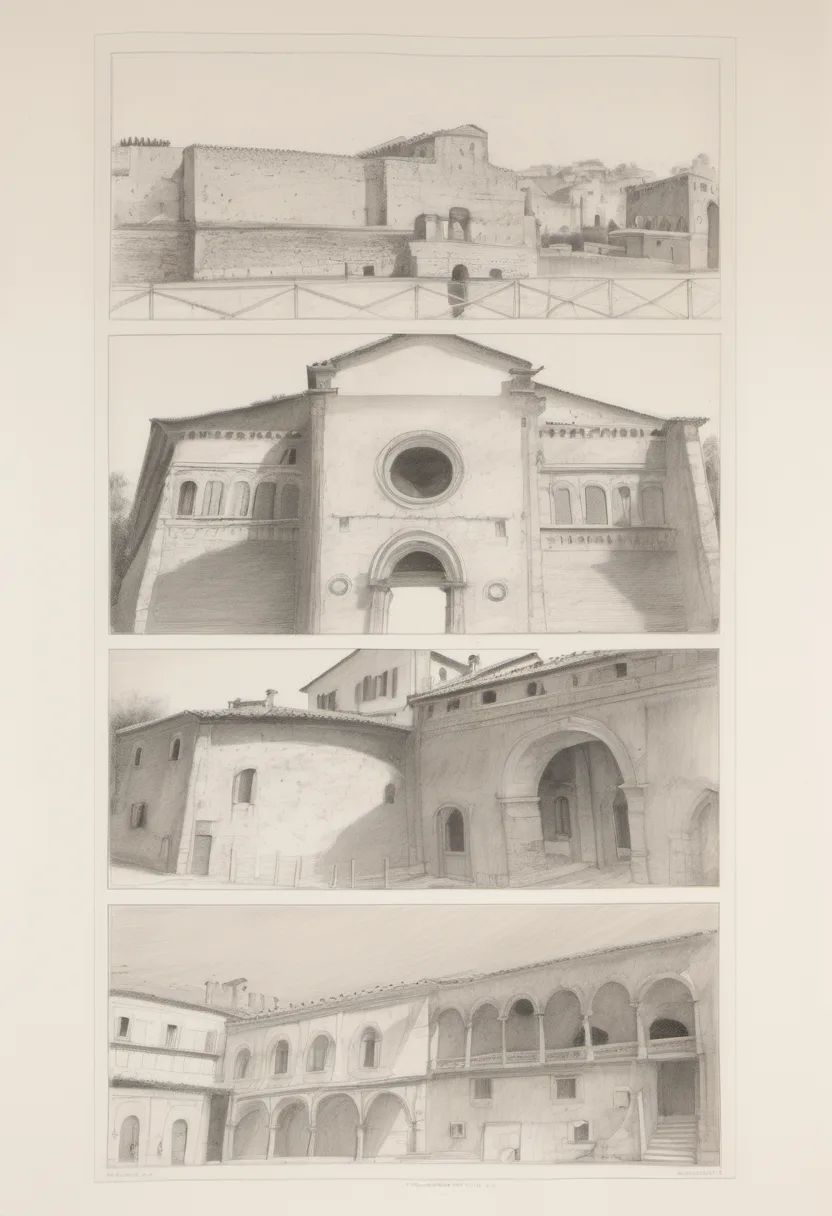
Fano, Italy
Fano is not a postcard. It is a hinge. Situated where the ancient Via Flaminia finally touches the Adriatic, this city of 59,000 has served as a military checkpoint, a Byzantine capital, and a Malatesta stronghold for two millennia. It is the third-largest city in the Marche, yet it retains a density that feels intimate rather than crowded.
The city’s identity is anchored by its name: Fanum Fortunae, the Temple of Fortune. This is not a marketing slogan. Beneath the medieval convent of Saint Augustine, you can still see the monumental podium of that sanctuary. It is a physical reminder that this place was once a focal point for Roman religious and political life, a site where the fate of the Republic was arguably decided during the Battle of the Metauro in 207 BC.
Walking Fano rewards you with layers. You step out of the 12th-century Cathedral into the shadow of the Arco d'Augusto, a Roman gate that survived a siege in 1463. You pass the Corte Malatestiana, a 14th-century palace that still holds the weight of its Gothic windows. The city is scarred by history—bombed in both World Wars, its bell towers deliberately destroyed by retreating Nazis in 1944—but it has rebuilt itself with a quiet, resilient dignity. It is a place where the past is not a museum, but a living structure you walk through.
To understand Fano, you must first understand the ground. The city sits on a slight elevation, with the Arco d'Augusto at 17 meters above sea level, overlooking the low-lying Piana del Metauro. This geography made it a strategic choke point. In 207 BC, the Roman legions defeated the Carthaginian general Hasdrubal on the banks of the Metauro river, just inland. The victory was so decisive that a temple to Fortuna was erected to commemorate it, giving the city its name: Fanum Fortunae. This was not a minor shrine; it was a statement of Roman triumph over Carthage, a monument to the turning point of the Second Punic War.
Julius Caesar held the city in 49 BC, and Augustus later established it as a colonia, building the defensive walls and the arch that still stand today. But Fano’s history is a palimpsest of destruction and rebuilding. In 538 AD, the Ostrogoths under Vitiges destroyed the city. The Byzantines rebuilt it, making it the capital of the maritime Pentapolis, a confederation of five coastal cities including Rimini and Ancona. This period cemented Fano’s role as a maritime hub, a status it maintained through the Longobard and Frankish occupations until it was donated to the Holy See in 754.
The medieval period brought the Malatesta family, who seized power in 1356. Galeotto I Malatesta built the Corte Malatestiana, a palace that blended Gothic severity with emerging Renaissance elegance. His descendant, Sigismondo Pandolfo Malatesta, transformed the city into a cultural and military fortress. He began the construction of the Rocca Malatestiana in 1433, a castle that would witness the end of Malatesta rule. In 1463, after a long siege by Papal troops under Federico da Montefeltro, Sigismondo’s son Roberto signed a peace treaty, ceding Fano to the Papal administration. The Arco d'Augusto was damaged during this siege, a scar that has never fully healed.
The city’s artistic heritage is a direct result of this political turbulence. The Church of San Francesco houses the tombs of Pandolfo III Malatesta and his wife Paola Bianca, designed by Leon Battista Alberti, a pioneer of Renaissance architecture. In Santa Maria Nuova, built in 1521, you can see works by Perugino, including the Fano Altarpiece, which may include an intervention by a young Raphael. These are not just paintings; they are artifacts of a city that was a battleground for artistic and political ideologies. The Museo Civico, housed in the Palazzo Malatestiano, holds works by Guido Reni, Domenichino, and Guercino, many of which survived the Napoleonic spoliations, though some, like a Reni sent to France, were never returned.
Fano’s modern history is marked by trauma. During World War I, it was bombed by the Austro-Hungarian Navy. In World War II, Allied forces targeted the strategic bridges over the Metauro river, causing massive destruction. When the Nazis withdrew in 1944, they destroyed nearly all the bell towers in the town, a deliberate act of sabotage that left the city’s skyline scarred for decades. The 1916 Rimini earthquake also caused significant damage, collapsing spires of the Cathedral and parts of the Church of Sant'Agostino. Despite this, Fano has maintained a distinct identity, even becoming known in the 20th century as the 'city of cauliflower,' with its Tardivo Fanese variety accounting for 20% of Italy’s exports in 1966.
Today, Fano is a city of contrasts. It is a place where the ancient and the modern coexist in a tense, productive dialogue. The Fano Jazz by The Sea festival brings contemporary culture to the ancient streets, while the Fano dei Cesari festival in summer celebrates its Roman past with chariot races and parades. The city is also known for its carnival, one of the oldest in Italy. But it is the quiet moments that define Fano: the light on the Arco d'Augusto at dusk, the smell of the sea from the Lido beach, the silence of the Piazza Andrea Costa, where in 2026, archaeologists uncovered the remains of the civic basilica described by Vitruvius in his De Architectura. This discovery is not just an archaeological find; it is a validation of the city’s ancient claim to architectural and historical significance. Fano is a city that has been broken, rebuilt, and broken again, and each time, it has emerged with a deeper, more complex identity.