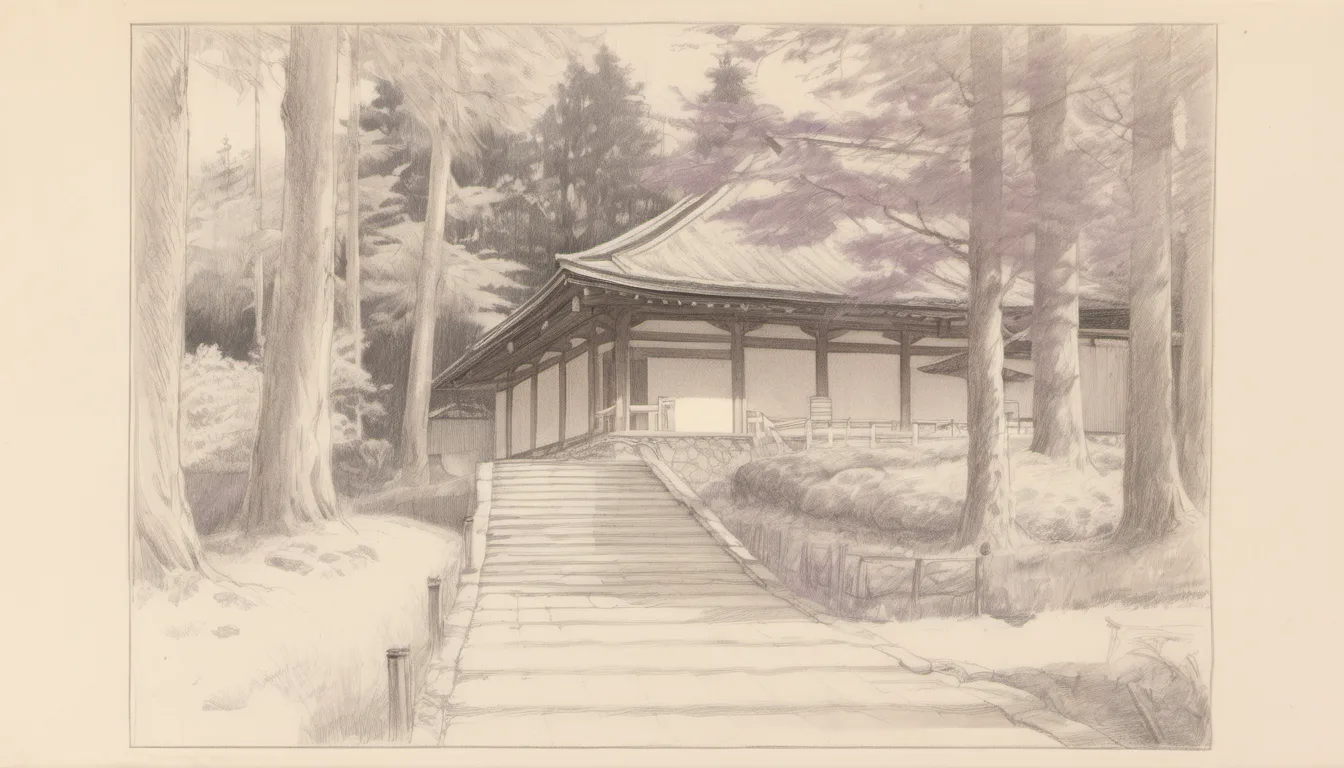
Hiraizumi, Japan
Hiraizumi is not merely a town in Iwate Prefecture; it is a basin of memory, nestled between the Kitakami Mountains where the Kitakami and Koromo rivers converge. For nearly a century, this valley served as the de facto capital of Ōshū, a realm that once commanded nearly a third of Japan’s landmass. Today, the population hovers around 7,400, but the landscape retains the weight of a golden age that rivaled Kyoto in splendor and size, peaking at over 100,000 souls.
The singular authority of this place rests on the Northern Fujiwara clan, who chose Mount Kanzan as their seat around 1100. Fujiwara no Kiyohira did not merely build a home; he constructed a theological and political statement. By situating his power south of the Koromo River—the traditional boundary with the Emishi peoples—he asserted sovereignty without Kyoto’s sanction. The resulting architecture, particularly Chūson-ji, was designed to mirror the Buddhist Pure Land, creating a physical manifestation of spiritual aspiration on earth.
Walking Hiraizumi rewards you with the tangible evidence of impermanence. The Konjikidō, or Golden Hall, remains a jewel-box of lacquer and gold, but it is the surrounding gardens that define the experience. The ruins of Kanjizaiō-in and Mōtsū-ji offer Pure Land style Jōdo Gardens, where water features and rock formations invite a slow, meditative pace. Here, the grandeur of the past is not shouted but whispered through the geometry of stone and water.
The town’s modern identity is shaped by its quiet decline after 1189, when the Fujiwara fell and the buildings were largely destroyed. It was Matsuo Bashō who, visiting in 1689, captured the essence of Hiraizumi in his famous haiku about summer grasses covering the dreams of warriors. This is a place to walk not for spectacle, but for the profound stillness that follows the collapse of empires. It is a landscape where history is felt in the silence between the ruins.
To understand Hiraizumi is to understand a specific moment in Japanese history when the center of gravity shifted north. Located in the Nishiiwai District of Iwate Prefecture, this small municipality occupies a basin surrounded by the Kitakami Mountains. While it is currently the smallest municipality in Iwate by area, covering just 63.39 square kilometers, its historical footprint was colossal. During the late Heian era, this valley was the heart of Ōshū, an autonomous region controlled by the Northern Fujiwara clan for roughly one hundred years.
The story begins in earnest around 1100, when Fujiwara no Kiyohira moved his residence from Fort Toyoda to Mount Kanzan. This location was strategically and symbolically significant. Kanzan sits at the junction of the Kitakami and Koromo rivers. Traditionally, the Koromo River marked the boundary between the Japanese south and the Emishi peoples to the north. By building his home south of this line, Kiyohira, who was half-Emishi himself, demonstrated a clear intention to rule Ōshū independently of the imperial court in Kyoto. He claimed Kanzan as the exact center of his domain, stretching from the Shirakawa Barrier in the south to Sotogahama in Aomori.
Kiyohira’s ambition was architectural as well as political. He initiated the construction of Chūson-ji, a massive temple complex on the mountain. The first structure was a large pagoda at the summit. To sanctify the approach, he placed small umbrella reliquaries, known as kasa sotoba, every hundred meters along the Ōshū Kaidō, the main road leading from Kyoto. These were decorated with placards depicting Amida Buddha painted in gold, creating a visual and spiritual corridor that guided pilgrims and dignitaries alike toward the sacred center.
The golden age of Hiraizumi lasted nearly a century, reaching a population of 50,000 to over 100,000, rivaling the capital in both size and splendor. The centerpiece of this era was the Konjikidō, or Golden Hall. This jewel-box structure was intended to represent the Buddhist Pure Land, serving as the final resting place for the Fujiwara lords. It was a masterpiece of lacquer, gold leaf, and intricate craftsmanship, designed to transport the viewer into a realm of eternal peace. The surrounding temples and gardens were not mere decorations but integral components of a cosmic map.
However, this prosperity was fragile. In 1189, the Northern Fujiwara clan was defeated, and Hiraizumi was destroyed. The town sank back into relative obscurity, and most of the buildings that had given it cultural prominence were lost to fire and time. Yet, the landscape remained. The ruins of Kanjizaiō-in and Mōtsū-ji, with their Pure Land style Jōdo Gardens, survived as testaments to a lost world. These gardens, with their carefully placed rocks and water features, invite contemplation of the transient nature of human achievement.
The poet Matsuo Bashō visited Hiraizumi in 1689, witnessing the state of the town after five centuries of decline. His reaction was not one of disappointment, but of profound philosophical reflection. He penned a haiku that has become synonymous with the town: 'Natsukusa ya / Tsuwamono-domo ga / yume no ato'—'Ah, summer grasses! / All that remains / Of the warriors' dreams.' This verse captures the essence of Hiraizumi: a place where the grand ambitions of warlords have been reclaimed by nature, leaving only the grass and the stones.
Today, Hiraizumi is recognized as a UNESCO World Heritage Site, a status achieved in 2011. The Historic Monuments and Sites of Hiraizumi include Chūson-ji, the Konjikidō, the ruins of Kanjizaiō-in and Mōtsū-ji, the ruins of Muryōkō-in, and the Takkoku-no-Iwaya Bishamon chapel. These sites are not just tourist attractions; they are national treasures that offer a unique insight into the Heian period’s religious and artistic achievements. The town’s economy now relies on agriculture and tourism, preserving the legacy of its past while sustaining its present.
The geography of Hiraizumi plays a crucial role in its character. Surrounded by the Kitakami Mountains, the town experiences a humid climate with mild summers and cold winters. The average annual temperature is 10.8 °C, with September being the wettest month and February the driest. This climate supports the lush vegetation that softens the ruins, creating a visual harmony between the built environment and nature. The changing seasons, particularly the cherry blossoms in spring and the foliage in autumn, add layers of beauty to the historical landscape.
Visiting Hiraizumi is an exercise in patience and observation. The town’s layout, centered around the JR East Tohoku Main Line station, allows for easy access to the key sites. From there, one can explore the Konjikidō, walk through the Pure Land gardens of Mōtsū-ji, and stand before the Takkoku-no-Iwaya Bishamon chapel. Each site offers a different perspective on the Fujiwara legacy, from the political to the spiritual. The experience is enriched by the knowledge that this was once a center of power and culture, now reduced to a quiet valley of memories.
The story of Hiraizumi is also a story of resilience. Despite the destruction of 1189, the town has persisted, adapting to changing political landscapes and economic realities. The local government, with its mayor-council system, works to preserve the town’s heritage while fostering community life. The presence of two public elementary schools and one middle school reflects the town’s commitment to its future, even as it honors its past. The international relations with Tiantai County in China further highlight Hiraizumi’s role as a bridge between cultures and histories.
In the end, Hiraizumi is a place to walk slowly, to let the silence speak. It is a reminder that empires rise and fall, but the grass grows, and the stones remain. The Golden Hall stands as a beacon of artistic achievement, but it is the gardens and the ruins that tell the deeper story. This is a town where history is not just recorded but felt, in the cool air of the basin and the warm gold of the hall. It is a place that rewards those who take the time to listen to the whispers of the past.