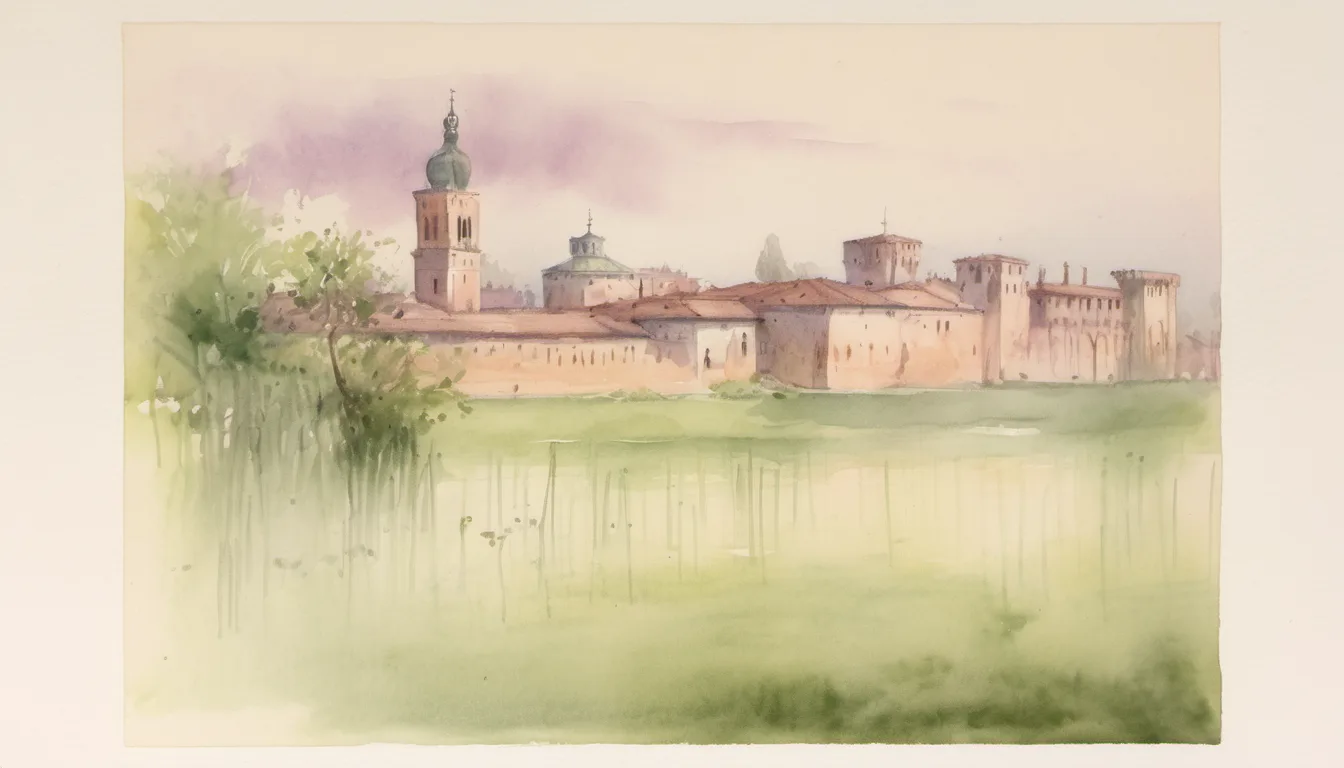
Mantova, Italy
Mantua is not a city you visit; it is a city you enter. In the twelfth century, the hydraulic engineer Alberto Pitentino reconfigured the Mincio River to surround the historic center with four artificial lakes. Today, three remain, turning the urban core into a peninsula of stone and water. You do not drive into Mantua; you cross the Ponte dei Mulini or the Ponte di San Giorgio, and the noise of the modern world falls away.
This isolation is the city’s defining feature. It is a place where the water is not a backdrop but a boundary, a moat, and a mirror. The architecture rises directly from the lake edges, creating a verticality that feels both defensive and intimate. When you walk the streets, you are walking on a stage set by medieval engineering, preserved with a precision that feels almost magical.
The reward for this slow approach is a density of art and history that rewards patience. From the frescoes of the Palazzo Ducale to the quiet gardens of the lakes, Mantua offers a curated experience of Italian urbanism. It is a place where the past is not a relic, but a living infrastructure. You come for the sights, but you stay for the silence of the water.
The foundation of Mantua is wrapped in myth, linked to the prophetess Manto, but its physical form is a triumph of engineering. In the twelfth century, Alberto Pitentino, acting on the orders of the Commune, organized the Mincio River to create a defensive perimeter of four lakes: Superiore, di Mezzo, Inferiore, and Paiolo. This hydraulic intervention transformed the city into an island, accessible only via two bridges. The Rio, a canal cut through the city, connected the lower and upper lakes, creating a sophisticated system of dikes and sluices that protected the urban core from flooding.
The city’s relationship with water has not always been benign. In the seventeenth century, a severe flood caused the Mincio to deposit solid materials, turning the lakes into unhealthy marshes. This environmental decay signaled a rapid decline in the city’s fortunes. To mitigate the damage, the southern lake, the Paiolo, was drained. This decision left Mantua as a peninsula, wet on three sides, a configuration that persists today. The remaining lakes are not natural; they are excavated features of the river’s bend, giving the city a surreal, almost floating quality that visitors often describe as magical.
The flora of these lakes is a mix of the indigenous and the exotic. The water hosts water chestnuts, water crowfoot, and white water lilies, but the most striking feature is the lotus flower (Nelumbo nucifera). Originally from Southeast Asia, these flowers were introduced to Italy in 1914 by Saverian fathers from Parma, who sought to use the starch from the rhizomes for food. Maria Pellegreffi, a young natural science graduate, transplanted the rhizomes to the Lago Superiore in 1921. While the culinary experiment failed, the flowers colonized the lakes, creating a spectacular bloom in July, August, and September. This introduction is controversial, as the lotus is an invasive species requiring massive periodic cutting to preserve the lake's integrity.
A local legend attempts to explain the lotus’s presence with a tragic romance. It tells of a young man who traveled to the East and met a woman with almond eyes and skin that smelled of lotus petals. When she came to Mantua and fell into the lake while looking at her reflection, the man threw lotus seeds into the water so that their annual bloom would remember her. Overcome by grief, he too disappeared into the waters. Whether you believe the myth or the botanical history, the sight of the floating islands of lotus from the Belfiore park is undeniably dramatic.
Mantua’s status as a cultural capital is formally recognized. In July 2008, it was inscribed on the UNESCO World Heritage list. Its importance as the capital of the first Marquisate and later the Duchy of Mantua is acknowledged in the Vittoriano in Rome, where it is represented among the fourteen noble cities as a symbol of the precursor to the Savoy monarchy and Italian unification. In 2016, the Ministry of Cultural Heritage named it the Italian Capital of Culture, and in 2017, the province was awarded the European Region of Gastronomy title alongside Bergamo, Brescia, and Cremona.
The city’s climate is subcontinental, characterized by strong humidity due to the surrounding water. Winter brings frequent fog and occasional snow, with the lakes freezing over in severe years, such as in 1985 and 2012. Summer is humid and still, with little ventilation in the Po Valley basin. This microclimate shapes the experience of walking the city, offering a cool, misty atmosphere in the cold months and a heavy, warm air in the heat.
The fauna of the Mincio Park is dominated by birds. Herons, moorhens, and coots build floating nests in the reed beds, while kites and owls hunt from the trees near the irrigation channels. The waters are populated by catfish, tench, carp, and eels. For visitors, the lakes offer a unique vantage point; cruises allow you to view the city’s architecture from the water, combining the historical and the natural in a way that is rare in Italy. The presence of wolves in the northern hills and the casual presence of ducks and swans along the lake shores complete the picture of a city that is both a museum and a wetland.
Mantua is a singular place in the Italian landscape. It is a city that was built to be defended by water, a city that was almost destroyed by that same water, and a city that has now embraced it as a source of beauty and identity. The walk through Mantua is a walk through layers of history, engineering, and myth, all reflected in the still, dark water of the Mincio.
Do not miss around Mantova
1 placeEvery place below is a ten-to-fifteen minute walk from the last.