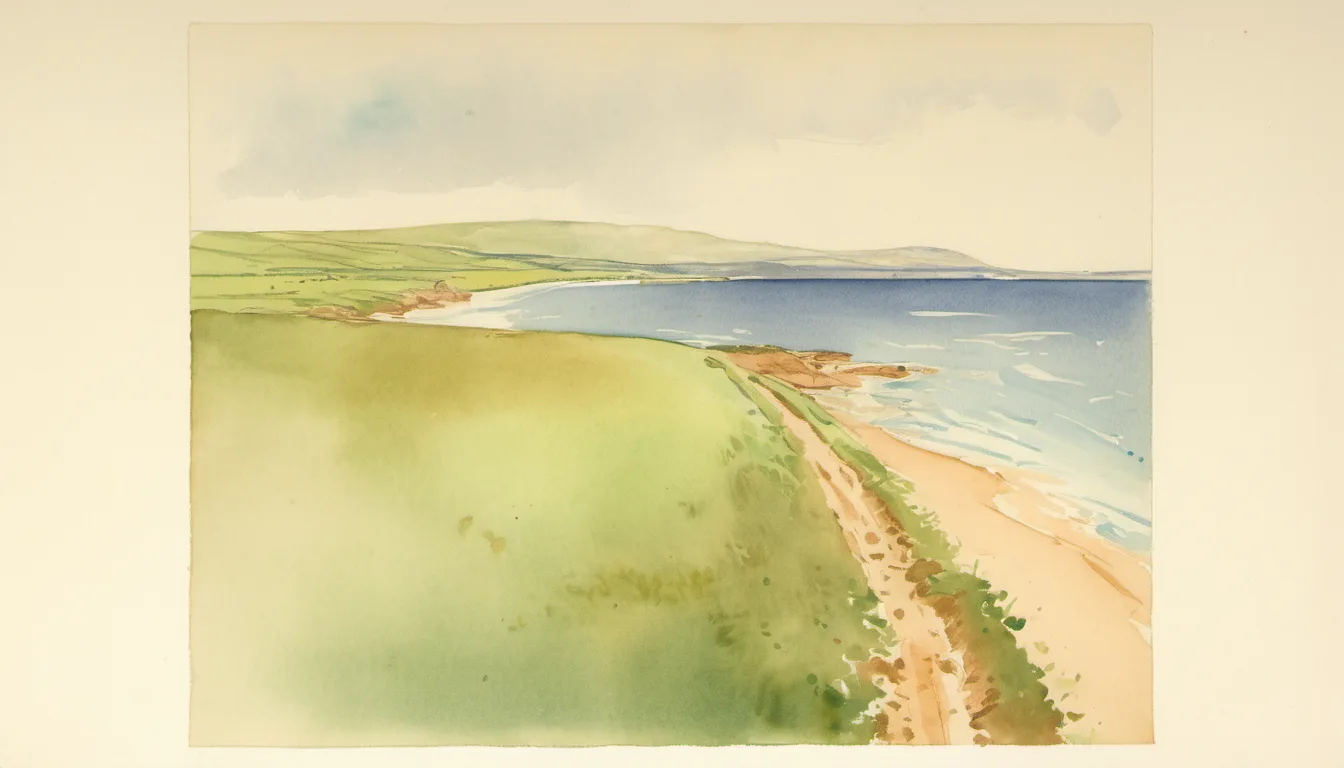
Orkney, United Kingdom
Orkney is not merely a destination but a geological pause, an archipelago suspended in the grey-blue expanse north of mainland Scotland. To walk here is to traverse time itself, where the air tastes of salt and ancient soil. The islands, known locally as the Orkneys, consist of roughly seventy isles, though only twenty are inhabited. The largest, Mainland, anchors the region with its fertile red sandstone and rolling pastures. It is a place defined by its margins, sitting ten miles from Caithness, yet culturally distinct from the mainland it mirrors.
The singular weight of Orkney lies in its prehistoric permanence. This is the Heart of Neolithic Orkney, a UNESCO World Heritage Site where the past is not buried but displayed. Here, the Standing Stones of Stenness stand guard over the Ring of Brodgar, massive stone circles that predate the pyramids. To walk these sites is to stand within the sightlines of people who lived eight thousand years ago. The landscape is not passive; it is a curated museum of earth and stone, where every horizon line has been shaped by millennia of wind and water.
Walking Orkney rewards the patient observer with a clarity rarely found elsewhere. The climate is mild, with winters averaging four degrees Celsius, yet the light is sharp and unfiltered. You will walk past the ruins of Skara Brae, Europe’s best-preserved Neolithic settlement, where stone furniture still holds the shape of human life. The path leads through farms where agriculture remains the economic backbone, but also through landscapes increasingly powered by wind and marine energy. Orkney generates more electricity from renewables than it consumes, a modern echo of its ancient resilience.
The people, known as Orcadians, speak a distinctive dialect of Scots, carrying forward a folklore rich with tales of seals and sea monsters. Their history is one of layers: Pictish, Roman, Norse, and Scottish. You will encounter the St Magnus Cathedral in Kirkwall, a Norman fortress of faith, and the quiet dignity of Stromness, a port town with two thousand souls. To walk Orkney is to understand that isolation breeds not stagnation, but a profound connection to the land. It is a place where the past is present, and the future is written in the wind.
Orkney, the Orkney Islands, stands as an archipelago off the north coast of Scotland, a cluster of seventy islands where twenty bear the weight of human habitation. It is part of the Northern Isles, alongside Shetland, positioned ten miles north of Caithness. The largest island, Mainland, spans 523 square kilometres, making it the sixth-largest in Scotland and the tenth in the British Isles. This is not a peripheral footnote but a central node of history, culture, and ecology. The administrative centre, Kirkwall, serves as the heartbeat of the region, home to the Orkney Islands Council and the imposing St Magnus Cathedral. Yet, the true soul of Orkney lies not in its towns, but in its stones.
The story of Orkney begins in the deep past, likely over ten thousand years ago. Late Upper Palaeolithic stone tools, belonging to the Ahrensburgian culture, have been unearthed in Stronsay and Brodgar, suggesting human presence around or prior to 8000 BC. A charred hazelnut shell, discovered in 2007 during excavations in Tankerness on Mainland, dates back to 6820–6660 BC, marking the presence of Mesolithic nomadic tribes. These early inhabitants left no grand monuments, but their presence is etched into the soil. The earliest known permanent settlement, Knap of Howar, a Neolithic farmstead on Papa Westray, dates from 3500 BC. It is a testament to early agricultural ingenuity, standing resilient against the elements.
As the Neolithic era unfolded, Orkney became a crucible of monumental architecture. The village of Skara Brae, often cited as Europe’s best-preserved Neolithic settlement, is believed to have been inhabited from around 3100 BC. Its stone houses, with their central hearths and dressers, offer an intimate glimpse into domestic life eight millennia ago. Nearby, the Standing Stones of Stenness and the Maeshowe passage grave stand as silent sentinels. The Ring of Brodgar, a massive stone circle, dominates the landscape, its purpose and origin still debated. Many of these settlements were abandoned around 2500 BC, possibly due to climatic shifts, leaving behind a landscape that feels curated by time itself. In September 2021, archaeologists announced the discovery of two polished stone balls in a 5500-year-old tomb on Sanday, one perfectly spherical and beautifully finished, hinting at a sophisticated symbolic culture.
The Bronze Age brought metalworking, slowly introduced from Europe, yet Orkney retained its ceremonial circles. Sites like the Plumcake Mound near the Ring of Brodgar and Tofts Ness on Sanday mark this transition. By the Iron Age, the landscape was dotted with Atlantic roundhouses and impressive broch towers, such as the Broch of Burroughston and Broch of Gurness. The nature of these structures remains a subject of scholarly debate. During the Roman invasion of Britain, the 'King of Orkney' was among eleven British leaders who submitted to Emperor Claudius in AD 43 at Camulodunum. Roman influence was limited to trade, with fleets possibly anchoring at Shapinsay, but the islands remained largely autonomous, integrated into the Pictish kingdom.
The Pictish era was followed by the influence of Dalriadic Gaels, who brought Celtic missionaries and improved manuring practices, enriching the soil for barley and oats. Islands bearing the epithet 'Papa' commemorate these monks. However, by the late 8th century, North Germanic peoples began to dispossess the Picts. The nature of this transition is controversial, ranging from peaceful integration to enslavement. Some suggest an assault by forces from Fortriu in 681, which 'annihilated' Orkney, weakened local power and facilitated the Norse arrival. This period marks a profound shift in the islands' identity, as Norwegian settlers flooded in during the late 8th and early 9th centuries.
Vikings made Orkney the headquarters for pirate expeditions against Norway and mainland Scotland. In response, Norwegian King Harald Fairhair annexed the Northern Isles in 875, a story recorded in the Orkneyinga Saga, though scholars note it may be apocryphal, based on later voyages of Magnus Barelegs. Rognvald Eysteinsson received Orkney and Shetland as an earldom, compensation for his son's death in Scotland, passing it to his brother Sigurd. The succession continued through Torf-Einarr, son of Rognvald and a slave, who founded a dynasty that controlled the islands for centuries. His son, Thorfinn Torf-Einarsson, ruled during the time of Erik Bloodaxe, who used Orkney as a base before being killed in 954.
The Christianization of Orkney is shrouded in mystery, though the Orkneyinga Saga suggests Olav Tryggvasson converted the islands in 995, stopping at South Walls. The Saga recounts how he summoned Count Sigurd the Strong and ordered him to be baptized. The transition from paganism to Christianity was gradual, with St Magnus Cathedral in Kirkwall becoming a Norman fortress of faith. The islands were later annexed by the Kingdom of Norway in 875, but in 1472, the Parliament of Scotland absorbed the Earldom of Orkney into Scotland. This occurred after the failure to pay a dowry promised to James III of Scotland by the family of his bride, Margaret of Denmark, a political maneuver that bound Orkney to Scotland forever.
Etymologically, the name Orkney is as layered as its history. Pytheas of Massalia, visiting between 322 and 285 BC, described a northern tip called Orcas, possibly Dunnet Head. Roman geographers Ptolemy and Pomponius Mela called them Orcades, as did Tacitus in AD 98. Etymologists interpret 'orc-' as a Pictish tribal name meaning 'young pig' or 'young boar,' with Old Irish speakers calling them Insi Orc, 'islands of the young pigs.' Norwegian settlers reinterpreted 'orc' as 'orkn,' meaning 'seal,' adding 'eyjar' for islands, creating Orkneyjar, or 'Seal Islands.' The plural suffix was later removed in English. Another name, Pomona, stems from a 16th-century mistranslation by George Buchanan, rarely used locally.
Today, Orkney is one of Scotland's 32 council areas, a constituency of the Scottish Parliament, and a lieutenancy area. The local council, Orkney Islands Council, is notable for having a majority of independent members. The climate is mild, with winter averages of 4°C and summer averages of 12°C. The soils are extremely fertile, supporting extensive agriculture, the primary economic sector. However, Orkney is also a pioneer in renewable energy. Significant wind and marine resources generate more electricity annually than the islands consume, making it a global leader in sustainable power. The landscape is dotted with wind turbines, their white blades turning against the grey sky, a modern symbol of Orkney's enduring resilience.
The people of Orkney, known as Orcadians, speak a distinctive dialect of Scots and maintain a rich body of folklore. The islands are abundant in marine and avian wildlife, offering a sanctuary for nature. Walking Orkney is an exercise in patience and observation. You will traverse the North Isles and South Isles, each with its own character. You will see the Old Red Sandstone that forms the geological base of almost all islands. You will encounter the quiet dignity of Stromness, with its 2,000 inhabitants, and St Margaret's Hope on South Ronaldsay. Orkney is not a place to rush; it is a place to linger, to listen to the wind, and to feel the weight of history in every stone.