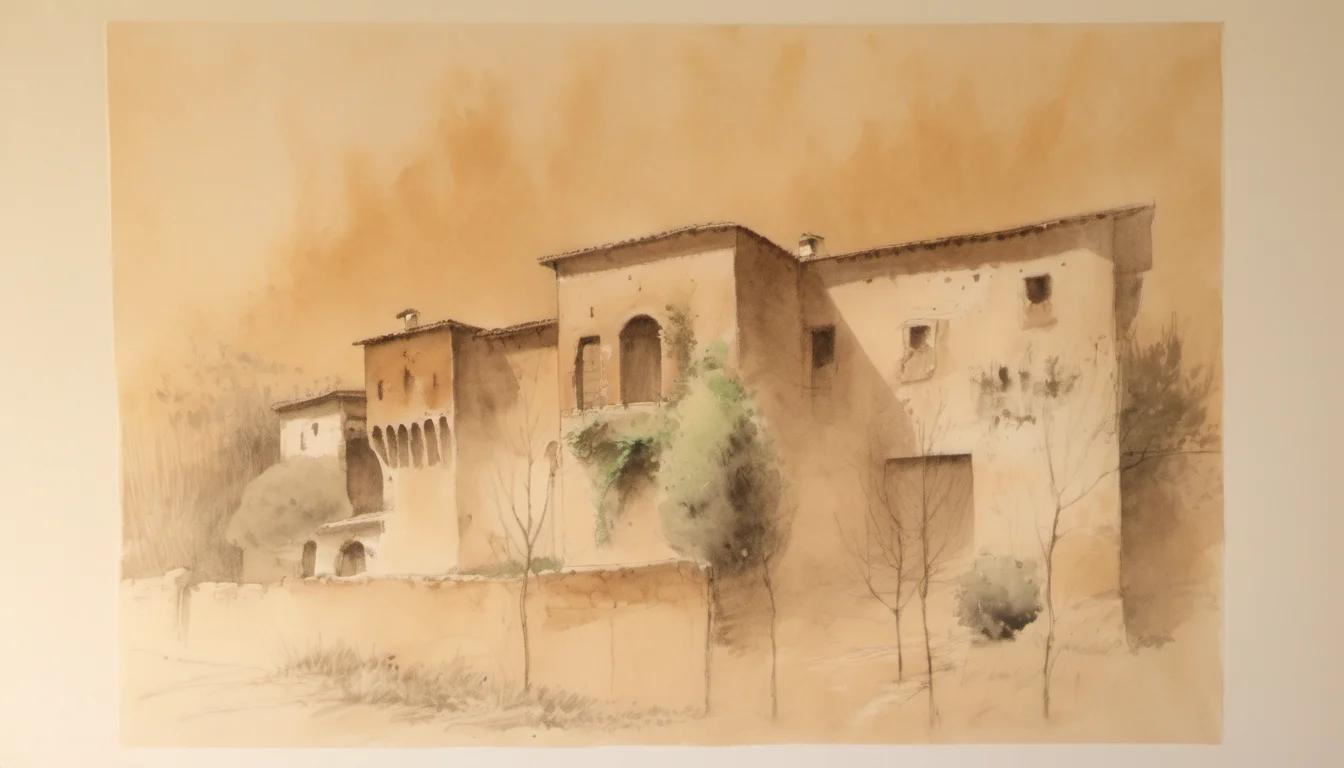
Spilamberto, Italy
Spilamberto sits on the western bank of the Panaro, a quiet hinge between the Po Valley and the Tuscan-Emilian Apennines. It is not a city of grand monuments, but a place where history is tasted before it is seen. The town’s identity is forged in the slow, dark aging of balsamic vinegar, a craft that defines its local economy and social rituals.
The name itself, first recorded in a 1026 diploma, hints at its thorny origins. Built in 1210 by Modena as a defensive response to Bologna’s nearby castle, it was a military outpost that evolved into a noble seat. The Rangoni family, powerful Modenese lords, governed it for centuries, leaving behind the Rocca Rangoni, a fortress that still anchors the skyline.
Walking here means navigating a compact medieval core where the church of San Giovanni Battista and the Sant’Adriano III stand as witnesses to a long, contested past. The streets are narrow, the architecture modest, but the air is thick with the scent of oak barrels. It is a place where you do not just visit; you linger, waiting for the next note of the local music or the next drop of vinegar to reveal the town’s true character.
Spilamberto’s story begins in the deep past, with hunter-gatherers present 100,000 years ago, but its political identity crystallizes in the early Middle Ages. The name 'Spinalamberti' appears in a 1026 diploma from Conrad II, granting tithes to the Church of Modena. This early documentation marks it as a significant ecclesiastical possession, a status that would shape its development for centuries.
The town’s physical form was born from conflict. In 1210, as Bologna completed the castle of Piumazzo, Modena built a defensive castrum on the opposite bank of the Panaro. This was not just a military act but a territorial assertion. The Bishop of Modena, Martino, simultaneously built the church of San Giovanni on the site of an older oratory. A dispute with the Abbot of Nonantola was resolved in 1214 by splitting the town into two jurisdictions: Spilamberto di Sotto and Spilamberto di Sopra, a division that left a lasting imprint on its layout.
From the mid-14th century, the town passed under the Este family, who granted it as a fief to the Rangoni. The Rangoni were a formidable noble house, holding titles across the Duchy of Modena and beyond. Their presence elevated Spilamberto from a mere outpost to a seat of power. The Rocca Rangoni, a medieval fortress, stands as a testament to this era, a stone reminder of the family’s long stewardship until the late 18th century.
Religious life in Spilamberto is complex, reflecting its dual origins. The church of Sant’Adriano III, built by the Abbot of Nonantola, became the first parish church within the walls in 1314. It houses significant artworks, including a statue of the Madonna and Child attributed to Michele da Firenze and altarpieces by Scarsellino. The church of San Giovanni Battista, meanwhile, holds the parish seat, a status formalized in 1628 when the plebanate was transferred from San Vito.
The town’s most famous product is its balsamic vinegar. The Consorteria of Traditional Balsamic Vinegar of Modena is based here, a direct result of the region’s agricultural heritage. This is not just a commodity; it is a cultural institution. The production is family-based, and the quality is fiercely guarded, a legacy of the careful stewardship that the Rangoni and later local families applied to the land.
In June, the town comes alive for the Fiera di San Giovanni, a fair with roots in the 16th century. It is the year’s most important event, drawing thousands for the exhibition of local products: amaretti, nocino, Lambrusco, and Parmigiano Reggiano. The highlight is the Palio di San Giovanni, a unique competition where only family-produced vinegars are entered. The tension is palpable, as no one knows the final ranking until the last moment. The winner earns the privilege of having their barrel branded with fire, a mark of supreme quality.
Spilamberto’s modern identity is also shaped by its role in the Second World War. The town was a theater of partisan resistance, and its population suffered significant sacrifices. This history is honored with the War Cross for Military Valor, a recognition of the community’s resilience. The town’s coat of arms, granted in 1862, features a thorn, a phonetic nod to the name 'Spina' (thorn), symbolizing both its difficult origins and its enduring strength.
Today, Spilamberto is a place of quiet dignity. It is a town where the past is not a museum exhibit but a living practice. The music of luthier Giovanni Cavani, whose instruments are known worldwide, adds a refined layer to its cultural fabric. Walking its streets, you are surrounded by the quiet persistence of a community that has turned its location on the river’s edge into a source of identity, flavor, and memory.
Do not miss around Spilamberto
1 placeEvery place below is a ten-to-fifteen minute walk from the last.