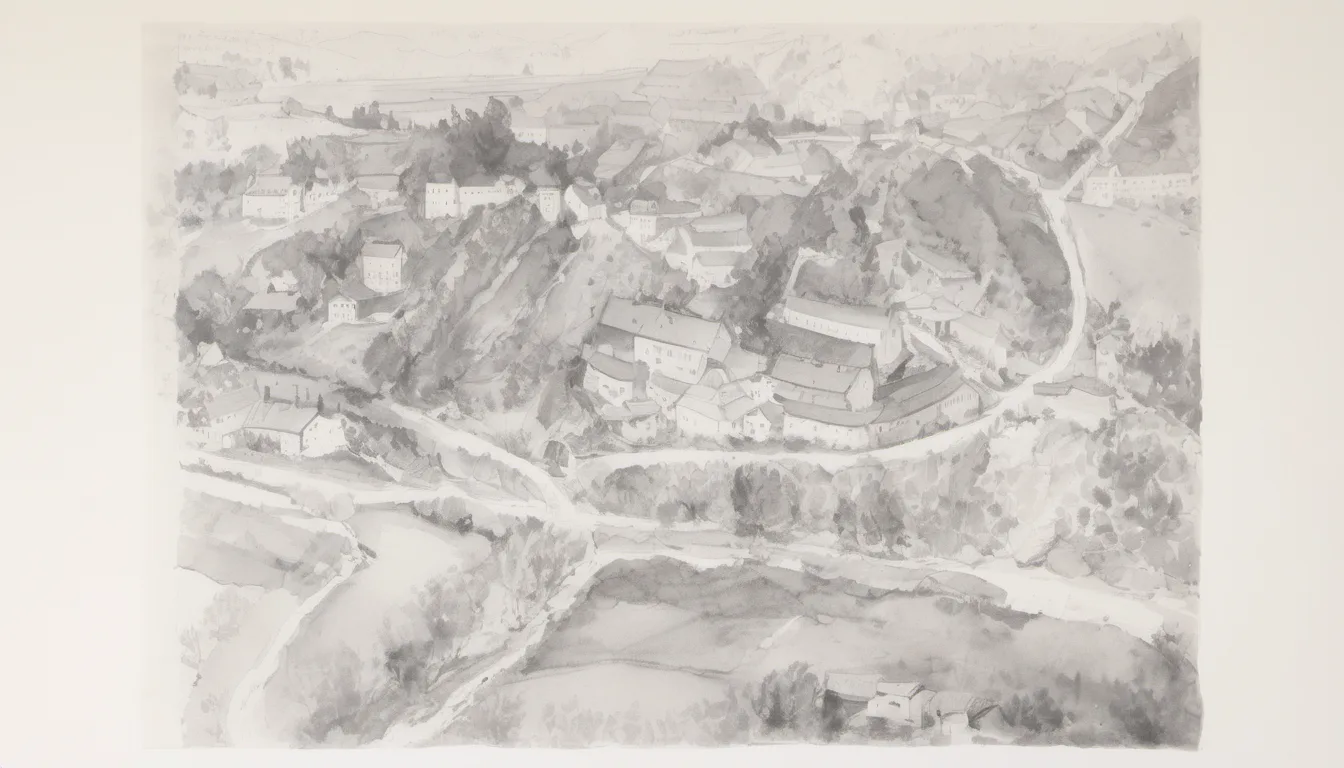
St. Gallen, Switzerland
St. Gallen does not shout; it resonates. Nestled in the rolling hills of eastern Switzerland, this city evolved from the quiet hermitage of an Irish missionary, Gallus, who arrived by the Steinach river in 612. Today, it stands as the capital of its canton and the intellectual heart of the region, home to one of Europe’s top business schools. But to understand St. Gallen, you must look past the modern service economy and trace the stone steps back to the 7th century, where faith and commerce first intertwined on this steep slope.
The city’s singular gravity is its Abbey, a UNESCO World Heritage site that dominates the skyline. This is not merely a religious monument but a living archive. Its library holds manuscripts dating to the 9th century, making it one of the oldest and most significant in the world. Walking through its cloisters is to walk through the preservation of Western knowledge itself. The architecture, the layout, and the sheer weight of history here create a atmosphere of profound stillness, a counterpoint to the bustling town that grew around it.
What makes walking St. Gallen rewarding is the vertical dialogue between the sacred and the civic. The town fought centuries of struggle to gain independence from the Abbey’s temporal power, a tension that shaped its urban fabric. You can feel this history in the steep streets that connect the lower town, with its guild halls and modern cafes, to the elevated Abbey. The city functions as the gate to the Appenzellerland, but its true gift is the layered narrative of independence, rebellion, and resilience etched into its stone.
To visit is to engage with a place where legends are not just stories but foundational myths. From the martyrdom of Saint Wiborada to the political machinations of Ulrich Varnbüler, St. Gallen is a city that has constantly negotiated its identity. It is a place where the past is not buried but built upon, offering a walking experience that is as much about reading the landscape as it is about seeing it. It is small, urban, and deeply, quietly significant.
St. Gallen is a city that has learned to speak softly, yet its voice carries across centuries. It evolved from the hermitage of Saint Gall, an Irish missionary who, according to legend, established himself by the river Steinach in AD 612. This humble beginning, marked by the planting of a pine tree, grew into the Abbey of St. Gall, founded by Saint Othmar around 720. Today, St. Gallen is the capital of the canton and the center of eastern Switzerland, a small urban agglomeration with around 167,000 inhabitants. Yet, its significance far exceeds its size, representing a unique convergence of religious heritage, academic prestige, and civic ambition.
The Abbey is the city’s anchor and its primary tourist attraction, a UNESCO World Heritage Site that stands as a testament to medieval monastic life. The Abbey’s library is its crown jewel, containing books from the 9th century, including the famous Plan of St. Gall, which offers a detailed map of an ideal monastery. The library’s survival through centuries of turmoil is a miracle of preservation. During the 9th century, the abbey prospered, becoming a site of pilgrimage and a center of trade, supported by guest houses, stables, a hospital, and one of the first monastery schools north of the Alps. By the tenth century, a settlement had grown up around the abbey, laying the groundwork for the modern city.
The city’s early history is marked by violence and resilience. In 926, Magyar raiders attacked the abbey and the surrounding town. Saint Wiborada, the first woman formally canonized by the Vatican, reportedly saw a vision of the impending attack and warned the monks and citizens to flee. While the monks and the abbey treasure escaped, Wiborada chose to stay behind and was killed by the raiders. Her martyrdom became a foundational legend of the city, symbolizing the intersection of faith and sacrifice. Between 924 and 933, the Magyars threatened the abbey again, and its books were removed for safekeeping to Reichenau, though not all were returned.
A fire on 26 April 937 consumed much of the abbey, spreading to the adjoining settlement, but the library was spared. Muslim invaders occupied the abbey in 939, and by 954, a protective wall was raised around it. Abbot Notker finished the wall by 975, and the adjoining settlement began growing into the town of St. Gall. From the 12th century, the town increasingly pushed for independence from the abbey. In 1180, an imperial reeve, not answerable to the abbot, was installed in the town. In 1207, Abbot Ulrich von Sax was granted the rank of Imperial Prince, making the Abbey a major regional power in northern Switzerland.
The city of St. Gallen gradually separated itself from the rule of the abbot. Abbot Wilhelm von Montfort granted special privileges to the citizens in 1291. By about 1353, the guilds, headed by the cloth-weavers guild, had gained control of the civic government. In 1415, the city bought its liberty from the German king Sigismund. In 1405, the Appenzell estates of the abbot successfully rebelled and became allies of the Old Swiss Confederation in 1411. The town of St. Gallen also became an ally, joining the 'everlasting alliance' as full members of the Confederation in 1454 and becoming completely free from the abbot in 1457.
However, the Abbey became an ally of Zürich, Lucerne, Schwyz, and Glarus in 1451. Ulrich Varnbüler, an early mayor of St. Gallen, emerged as a key figure. His father, Hans, was prominent in city affairs in the early 15th century. Ulrich entered public affairs in the early 1460s and demonstrated fine qualities as field commander of the St. Gallen troops in the Burgundian Wars. In the Battle of Grandson (1476), his troops were part of the advance units of the Confederation and took part in their famous attack. A large painting of Ulrich returning triumphantly to a hero's welcome in St. Gallen is still displayed in the city.
After the war, Varnbüler often represented St. Gallen at the various parliaments of the Confederation. In December 1480, he was offered the position of mayor for the first time. From that time on, he served in several leadership positions and was considered the city's intellectual and political leader. According to Vadian, 'Ulrich was a very intelligent, observant, and eloquent man who enjoyed the trust of the citizenry to a high degree.' His reputation among the Confederates was also substantial, but in the late 1480s, he became involved in a conflict that was to have serious negative consequences for him and for the city.
In 1463, Ulrich Rösch had assumed the management of the abbey of Saint Gall. He was an ambitious prelate, whose goal was to return the abbey to prominence by every possible means, following the losses of the Appenzell War. His restless ambition offended the political and material interests of his neighbors. When he arranged for the help of the Pope and the Emperor to carry out a plan to move the abbey to Rorschach on Lake Constance, he encountered stiff resistance from the St. Gallen citizenry, other clerics, and the Appenzell nobility in the Rhine Valley, who were concerned for their holdings. At this point, Varnbüler entered the conflict against the prelate.
He wanted to restrain the increase of the abbey's power and at the same time increase the power of the town that had been restricted in its development. For this purpose, he established contact with farmers and Appenzell residents (led by the fanatical Hermann Schwendiner) who were seeking an opportunity to weaken the abbot. Initially, he protested to the abbot and the representatives of the four sponsoring Confederate cantons (Zürich, Lucerne, Schwyz, and Glarus) against the construction of the new abbey in Rorschach. Then on 28 July 1489, he had armed troops from St. Gallen and Appenzell destroy the buildings already under construction, an attack known as the Rorschacher Klosterbruch.
When the Abbot complained to the Confederates about the damage and demanded full compensation, Ulrich responded with a countersuit, and in cooperation with Schwendiner rejected the arbitration efforts of the non-partisan Confederates. He motivated the clerics from Wil to Rorschach to abandon their loyalty to the abbey and spoke against the abbey at a meeting of the townspeople at Waldkirch, where the popular league was formed. He was confident that the four sponsoring cantons would not intervene with force, due to the prevailing tensions between the Confederation and the Swabian League. He was strengthened in his resolve when the people of St. Gallen re-elected him as their highest magistrate in 1490.
Ulrich Varnbüler had made a serious miscalculation. In early 1490, the four cantons decided to carry out their duty to the abbey and to invade the St. Gallen canton with an armed force. The people of Appenzell and the local clerics submitted to this force without significant resistance, while the city of St. Gallen braced itself for a fight to the finish. However, when they learned that their compatriots had given up the fight, they lost confidence, and they agreed to a settlement that greatly restricted the city's power and burdened the city with serious penalties and reparation payments. Ulrich, overwhelmed by the responsibility for his political decisions, panicked in the face of the approaching enemy who wanted him apprehended. His life was in great danger, and he was forced to escape from the city disguised as a messenger. He made his way to Lindau and to Innsbruck and the court of King Maximilian. The victors confiscated those of his properties that lay outside of the city of St. Gallen and banned him from the Confederation. Ulrich then appealed to the imperial court (as did Schwendiner, who had fled with him) for the return of his property. The suit had the support of Friedrich II and Maximilian and the trial threatened to drag on for years: it was continued by Ulrich's sons Hans and Ulrich after his death in 1496, and eventually the Varnbülers regained their properties. However, other political ramifications resulted from the court action, because the Confederation gained ownership of the city of St. Gallen and rejected the inroads of the empire. Thus, the conflict strengthened the relationship between the Confederation and the city of St. Gallen. On the other hand, the matter deepened the alienation between Switzerland and the German Holy Roman Empire, which eventually led to a total separation after the Swabian War. Despite the unpropitious end of his career, Ulrich Varnbüler is immortalized in a famous woodcut by Albrecht Dürer, which is now part of the Smithsonian Institution's woodcut collection.