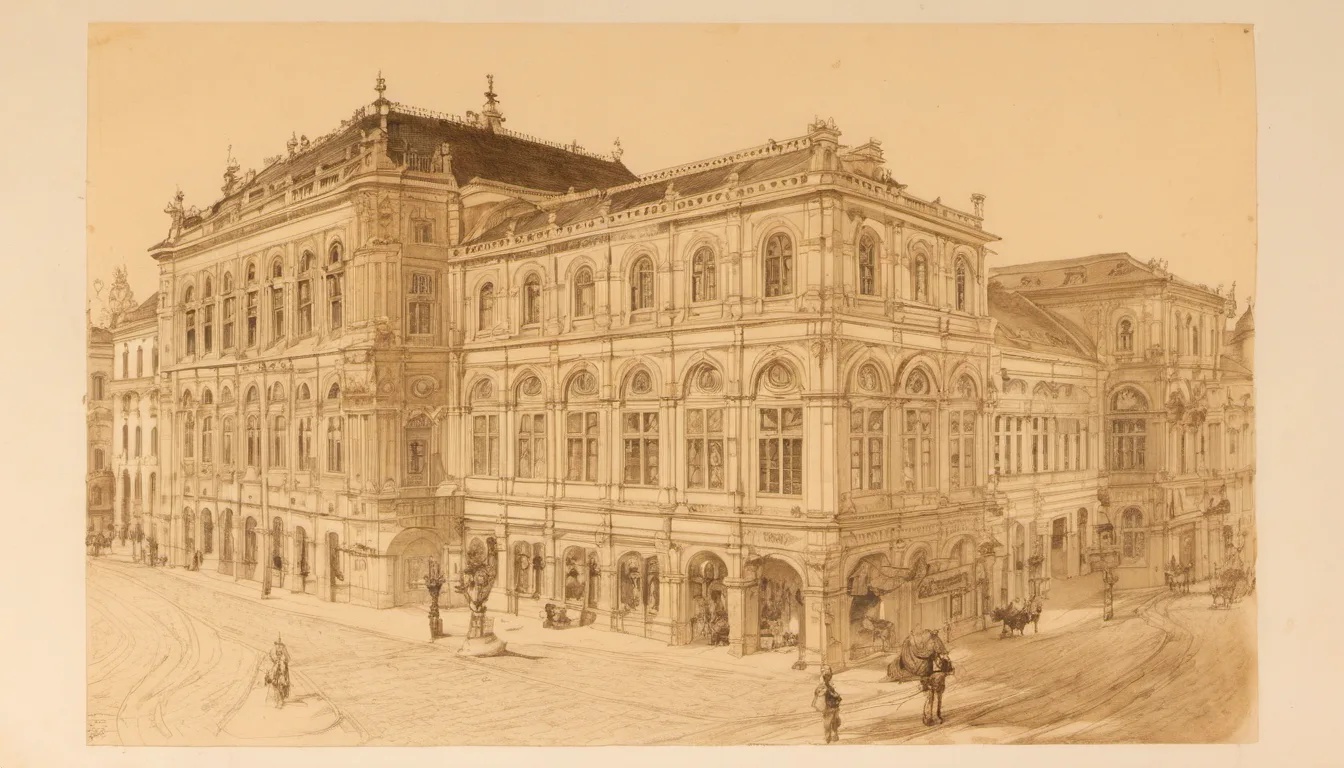
Vienna, Austria
Vienna does not announce itself with the frantic energy of a metropolis trying to prove its relevance. It arrives with a quiet, imperial gravity, a city that has spent centuries perfecting the art of appearing effortless while holding the levers of European power. To walk here is to move through layers of time that feel less like history and more like present tense, preserved in stone and sound. The city is not merely a backdrop for culture; it is the culture, embedded in the very geometry of its streets and the rhythm of its rivers.
The city’s identity is defined by a singular tension: the interplay between rigid order and fluid expression. This is visible in the Ring, the grand boulevard tracing the line of former walls, where monumental palaces stand in stoic formation. It is heard in the air, thick with the echoes of composers who turned this capital into the world’s musical heart. From Vivaldi to Schönberg, Vienna has been the crucible for musical evolution, a place where innovation was often born from tradition rather than in spite of it. Walking here rewards you with an understanding of how art and politics have long been intertwined.
Geographically, Vienna is a study in contrasts. The southern periphery is flat and industrial, while the north rises into the green foothills of the Wienerwald. The Danube cuts through the eastern edge, flanked by artificial channels and the Donauinsel, a long, narrow strip of land created for flood protection but now used for leisure. This island, along with the Alte Donau, offers a respite from the urban density, a place where locals gather under the sun. It is a reminder that Vienna’s grandeur is balanced by a deep, practical relationship with its natural environment.
What makes Vienna matter is its resilience. Having survived Roman encampments, Turkish sieges, and the devastation of World War II, the city has consistently rebuilt itself with a commitment to aesthetic and civic excellence. The reconstruction was not just about restoring buildings; it was about restoring a sense of continuity. Today, Vienna stands as a hub for international organizations, from OPEC to the IAEA, yet it retains the soul of a city where the past is not archived but lived. To walk its streets is to witness a civilization that values endurance, elegance, and the enduring power of a well-composed phrase.
Vienna is a city that has long understood the value of a good stage. From its earliest days as Vindobona, a Roman military camp established around 89 AD to protect the nearby settlement of Carnuntum, the city has been a crossroads. It was here, perhaps, that Emperor Marcus Aurelius died on March 17, 180 AD, during his second Germanic campaign. The old walls built between 100 and 500 AD still stand, a silent testament to the city’s early strategic importance. But it was not until the Middle Ages that Vienna began to assert its true dominance. Charlemagne incorporated it into the Eastern March, or Ostmark, though it remained vulnerable to Hungarian raids until Otto I’s decisive victory in 955. In 976, the Babenberg dynasty was granted control, with Leopold I named margrave, setting the stage for Vienna’s rise.
The Babengs gave Vienna its primacy in the region, though they had to contend with persistent Hungarian pressure. This era ended in 1246 with the death of Frederick II in battle, leading to an Interregnum marked by Bohemian rulers. The turning point came in 1278 when Rudolf of Habsburg defeated Ottokar, establishing Habsburg rule that would last until 1918. Initially unpopular, with a rebellion crushed in 1288, the Habsburgs eventually secured Vienna’s status as the imperial capital when Albert II moved the seat of power here in 1438. Under Maximilian I, the city experienced a cultural flowering, and in 1365, the University was founded, cementing Vienna’s role as a center of learning and art.
The Renaissance brought both power and peril. In 1533, the power center moved to the Hofburg, the traditional imperial palace. Yet, foreign invasions persisted. From 1485 to 1493, the city was under the dominion of Matthias Corvinus, King of Hungary, before being reclaimed by Maximilian. By the early 16th century, the Ottoman threat loomed large. The 16th century was marred by religious wars, with Vienna divided between Protestantism, which held about 80% support under Maximilian II, and Catholicism, which emerged victorious after subsequent persecutions and the Counter-Reformation. These religious conflicts contributed to the Thirty Years’ War, during which the city was devastated by plague, claiming approximately 30,000 lives.
The true rebirth of Vienna came after the definitive defeat of the Turks. In 1683, Kara Mustafa’s forces reached the city’s gates, threatening all of Christendom. Prince Eugene of Savoy defeated them repeatedly, saving the city. The late 17th and early 18th centuries saw a massive urban awakening. Under Charles VI, the Karlskirche and the sumptuous Belvedere Palace were built, along with noble residences around the Hofburg. In 1738, the Peace of Vienna was signed, ending the War of the Polish Succession. This period marked Vienna’s emergence as a premier artistic capital, blending political power with aesthetic grandeur.
Maria Theresa ascended the throne in 1740, the first empress, following Charles VI’s Pragmatic Sanction. She ruled for forty years, moving the imperial residence to Schönbrunn Palace, which she commissioned on the city’s periphery. Her patronage elevated Vienna’s status, fostering music and bringing Wolfgang Amadeus Mozart to prominence. Her successor, Joseph II, was a liberal reformer who clashed with conservative aristocracy and the Church. His reforms, known as Josephinism, modernized Austrian legislation according to Enlightenment principles, introducing a penal code that reflected these new ideals, even if it faced resistance from entrenched powers.
Vienna’s geography mirrors its complex history. Located in northeast Austria, it sits 40km from the Slovak border and 50km from Bratislava. The city comprises 23 districts, spiraling outward from the first, the historic center. The Ring, a boulevard tracing the old walls, is one of Europe’s most refined avenues, lined with prestigious palaces and historical buildings, a masterpiece of urban planning. A second ring, the Gürtel, is the city’s busiest road, hosting the elevated U6 metro line from Westbahnhof to the Danube. This infrastructure reflects the city’s growth and its need to manage the flow of people and power.
The Danube plays a crucial role in Vienna’s identity. It flows through the eastern part of the city, while the Donaukanal, an artificial channel following an ancient branch, borders the historic center. On the opposite bank, the Alte Donau, cut off by river regulation, has become a lake. Between 1972 and 1988, a second regulation created the Neue Donau, a parallel channel that forms a long lake, designed to discharge high waters and relieve the main river. Separating these is the Donauinsel, a long, thin strip of land created for flood protection but now a popular park for sports and relaxation.
The Donauinsel hosts the Donauinselfest, a three-day music festival held annually in late June, celebrating the city’s vibrant cultural life. This event underscores Vienna’s ability to blend its historical grandeur with contemporary community spirit. The city’s climate is relatively mild continental, with long, cold winters featuring frequent snowfalls, especially in January. Summers are warm, though cooler days occur due to rains from northwest Europe. Annual precipitation averages 600mm, with mean temperatures of 10.4°C in the center and 9.8°C in the surroundings, providing a backdrop that has shaped the city’s architectural and social rhythms.
Vienna’s musical heritage is unparalleled. It has hosted many of the greatest composers of the 18th and 19th centuries, including Antonio Vivaldi, Niccolò Paganini, Christoph Willibald Gluck, Mozart, Haydn, Salieri, Beethoven, Rossini, Schubert, the Strauss family, Brahms, Bruckner, Liszt, Mahler, and Schönberg. This concentration of talent transformed Vienna into a global center for musical innovation. The city’s architecture, featuring Baroque examples and as the cradle of the Jugend style, complements this auditory legacy. Over half the city is green space, including parks, gardens, and forests, serving as social hubs and offering respite from urban life.
Today, Vienna is a major industrial center, with industries in electronics, textiles, food, steel, chemicals, and precision mechanics. It is also a hub for international organizations, including OPEC, the IAEA, and the UN. The city center, declared a UNESCO World Heritage site, stands as a testament to its historical significance. After severe destruction in World War II, Vienna’s architectural and monumental heritage was rebuilt and enhanced, reflecting a commitment to preserving and strengthening its cultural identity. The city’s ability to balance its imperial past with its modern role as a diplomatic and industrial center makes it a singular place in Europe.
Walking through Vienna is an exercise in observing the interplay between the grand and the intimate. The city’s history is not confined to museums but is lived in its streets, its music, and its landscapes. From the Roman roots of Vindobona to the Habsburg splendor, from the religious conflicts of the 16th century to the musical genius of the 18th and 19th, Vienna has consistently reinvented itself while maintaining its core identity. It is a city that rewards the walker with a deep appreciation for the enduring power of art, politics, and resilience, making it a place where every step reveals a new layer of its complex, beautiful history.