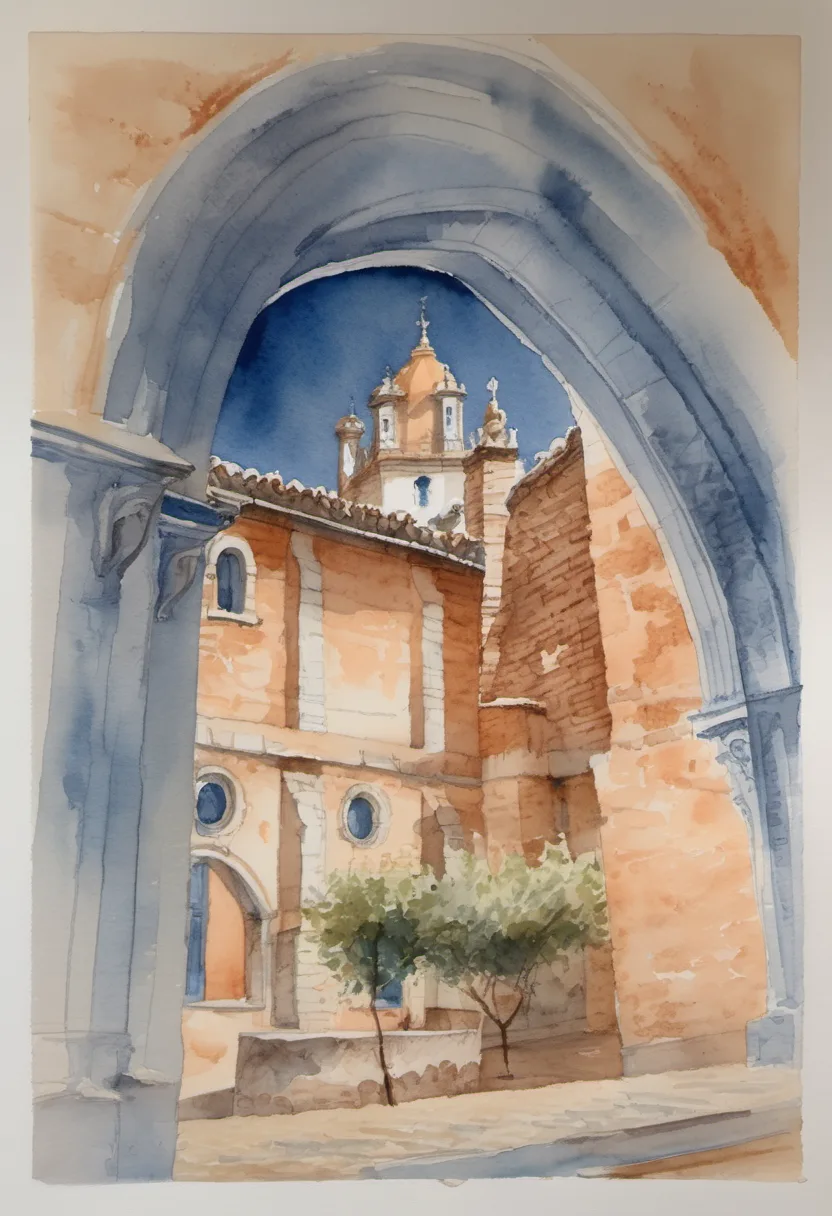
Évora, Portugal
Évora does not announce itself. It sits in the Alentejo plains, a medium-sized city of 53,591 inhabitants, enclosed by walls that have held firm since Roman times. To walk here is to move through layers of history that feel less like a museum exhibit and more like a living, breathing organism. The air is thick, the stone is warm, and the silence is heavy with the weight of five millennia.
The city’s singular character comes from its preservation. Unlike Lisbon or Porto, which have been reshaped by modernity, Évora’s historic center remains a labyrinth of 4,000 buildings within just over a square kilometer. It is the historic capital of the Alentejo, a title that carries more than geographical weight. It implies a cultural gravity, a center of gravity for the south of Portugal, where the court resided for long periods, where kings were crowned, and where the fate of a kingdom was debated in shadowed cloisters.
Walking the city rewards those who look down as much as up. The streets are not merely thoroughfares; they are archives. You will pass the Roman Temple, its Corinthian columns standing defiantly against the sky, and then turn a corner to find the Chapel of Bones, where the skulls and femurs of 5,000 monks form a macabre yet beautiful decorative scheme. It is a reminder of the transience of life, a theme that permeates the Alentejo’s stoic landscape.
The heat is a constant companion. Evora is one of Portugal’s hottest cities, with summer temperatures frequently breaking 40°C. Yet this heat is not an obstacle; it is part of the city’s rhythm. It forces a slower pace, a midday pause, a respect for the sun. The narrow streets offer respite, the whitewashed walls reflect the light, and the shade of the plane trees becomes a sanctuary. To walk Évora is to learn the art of waiting, of letting the heat dictate the tempo of your exploration.
This is a city that has survived empires, invasions, and earthquakes. It was a Roman hub, a Moorish agricultural center, a medieval royal residence, and a Jesuit stronghold. Each era has left its mark, not in isolation, but in a palimpsest of stone and spirit. Today, it stands as a European Capital of Culture for 2027, a recognition of its enduring relevance. But for the walker, the value is not in the accolades. It is in the feeling of walking through time, where every stone has a story, and every shadow holds a memory.
Évora is not a city that shouts. It whispers in the language of stone, heat, and history. Located 140 kilometers south of Lisbon and 80 kilometers from the Spanish border, it sits in the heart of the Alentejo, a region of wide plains and golden wheat. With a population of 53,591, it is a medium-sized city, yet it carries the weight of a capital. It is the historic capital of the Alentejo, the seat of the district, and a place where the past is not behind you, but around you, in the thick walls that still partially enclose the old town.
The story of Évora begins more than five millennia ago. The Celtici, a tribal confederacy, named it Ebora, likely derived from the Celtic word for yew trees. This etymology links it to York, known in Roman times as Eboracum, or 'Place of Yew Trees.' Whether named for the trees, for gold (aurum), or for ivory workers, the name suggests a place of value. By 57 BC, the Romans had conquered it, expanding it into a walled town and calling it Liberalitas Julia. It flourished as a junction of important routes, a city of wheat fields, and a center of commerce. The monumental Corinthian temple in the center, dating from the first century, stands as a testament to its high rank among Roman municipalities, likely erected in honor of Emperor Augustus.
The Roman era gave way to Visigothic rule, then to Arab Islamic conquest in 715. The Moors named it Yāburah and slowly transformed it into an agricultural center with a fortress and a mosque. The Arab influence is still visible in the character of the historical city, in the layout of the streets, and in the resilience of its people. Notables like the poet Abd al-Majid ibn Abdun Al-Yaburi emerged from these streets, their diwans surviving to this day. The city prospered under the Taifa of Badajoz, developing a distinct identity that would persist through the centuries.
In September 1165, the city was wrested from the Moors by Gerald the Fearless (Geraldo Sem Pavor) in a surprise attack. It came under the rule of King Afonso I of Portugal in 1166. The last Muslim attempt to regain the city failed in 1181, and Évora began to flourish as one of the most dynamic cities in the Kingdom of Portugal. The court of the first and second dynasties resided here for long periods, constructing palaces, monuments, and religious buildings. It became a scene for royal weddings and a site where important decisions were made, solidifying its status as a political and cultural hub.
The Manueline era, particularly under Kings Manuel I and John III, saw Évora become a major center for the humanities and arts. It was a city of scholars and artists: André de Resende, Nicolau Chanterene, Cristóvão de Figueiredo, Gregório Lopes, Manuel Cardoso, Duarte Lobo, Duarte Galvão, and Gil Vicente, the father of Portuguese drama. The city was a beacon of intellectual life, attracting European masters like the Flemish humanists Clenardus and Johannes Vasaeus. Yet, this prosperity was shadowed by social tension. In 1535, Nicolas Cleynaerts, a Flemish tutor, exclaimed that in Évora, 'it was as if I had been carried off to a city in hell: everywhere I only meet blacks,' a stark reflection of the social realities of the time.
In 1540, the city became the seat of an archbishopric. The Jesuits founded the university in 1559, spreading intellectual and religious enlightenment. However, the Marquis of Pombal closed the university in 1759 after expelling the Jesuits, and Évora entered a period of decline. The university was not reopened until 1973. This period of neglect did not erase the city’s heritage; instead, it preserved it. The monuments erected by major artists of each period now testify to Évora’s rich artistic and historical legacy. The variety of architectural styles—Romanesque, Gothic, Manueline, Renaissance, Baroque—creates a unique urban fabric.
The 19th century brought violence and upheaval. On July 29, 1808, during the Peninsular War, the Battle of Évora was fought. An outnumbered Portuguese-Spanish force of 2,500, assisted by poorly armed peasant militiamen, tried to stop a French-Spanish division commanded by Louis Henri Loison, known as 'Maneta' or 'One-Hand.' The defense was routed, and the French stormed the town, slaughtering combatants and non-combatants alike. The invasion inflicted as many as 8,000 casualties. In 1834, Évora was the site of the surrender of King Miguel I’s forces, marking the end of the Liberal Wars. These events left deep scars, but also a resilience that defines the city today.
An earthquake in 1909 damaged the city, but it was rebuilt, retaining its historic character. Today, Évora is a UNESCO World Heritage Site, recognized for its well-preserved old town center and monuments dating from various historical periods. It is ranked number two in the Portuguese most livable cities survey, a testament to its quality of life. It was also ranked first in a study concerning the competitiveness of Portuguese district capitals. These accolades reflect not just its history, but its present vitality.
Walking Évora is an exercise in contrast. The heat is intense, with summer temperatures frequently exceeding 40°C. Yet, the city’s layout, with its narrow streets and shaded squares, offers respite. The whitewashed walls reflect the sun, and the plane trees provide shade. The city’s altitude of 300 meters offers a slight relief from the extreme heat of the interior plains. The climate is hot-summer Mediterranean, with hot, dry summers and mild, moist winters. The heat is not just a weather condition; it is a cultural force, shaping the rhythm of life, the timing of meals, and the pace of conversation.
The city’s singular character lies in its preservation and its layers. The Roman Temple stands in the center, a reminder of the city’s ancient roots. The Chapel of Bones, with its skulls and femurs, offers a macabre yet beautiful meditation on mortality. The Manueline palaces and Baroque churches speak to the city’s golden age. The narrow streets and squares form a picturesque labyrinth, inviting exploration. Each corner reveals a new detail, a new story, a new layer of history. To walk Évora is to walk through time, to touch the stone that has witnessed empires rise and fall, to feel the heat that has shaped its people, and to hear the whispers of the past in the silence of the present.
Évora is not a city for the hurried. It demands time, attention, and respect. It is a city that has survived invasions, earthquakes, and neglect, emerging each time with its heritage intact. It is a city that has been a Roman hub, a Moorish center, a medieval royal residence, and a Jesuit stronghold. It is a city that has produced poets, artists, scholars, and kings. It is a city that is now a European Capital of Culture for 2027, a recognition of its enduring relevance. But for the walker, the value is not in the accolades. It is in the feeling of walking through time, where every stone has a story, and every shadow holds a memory. It is a city that invites you to slow down, to listen, and to understand.