Admont, Austria
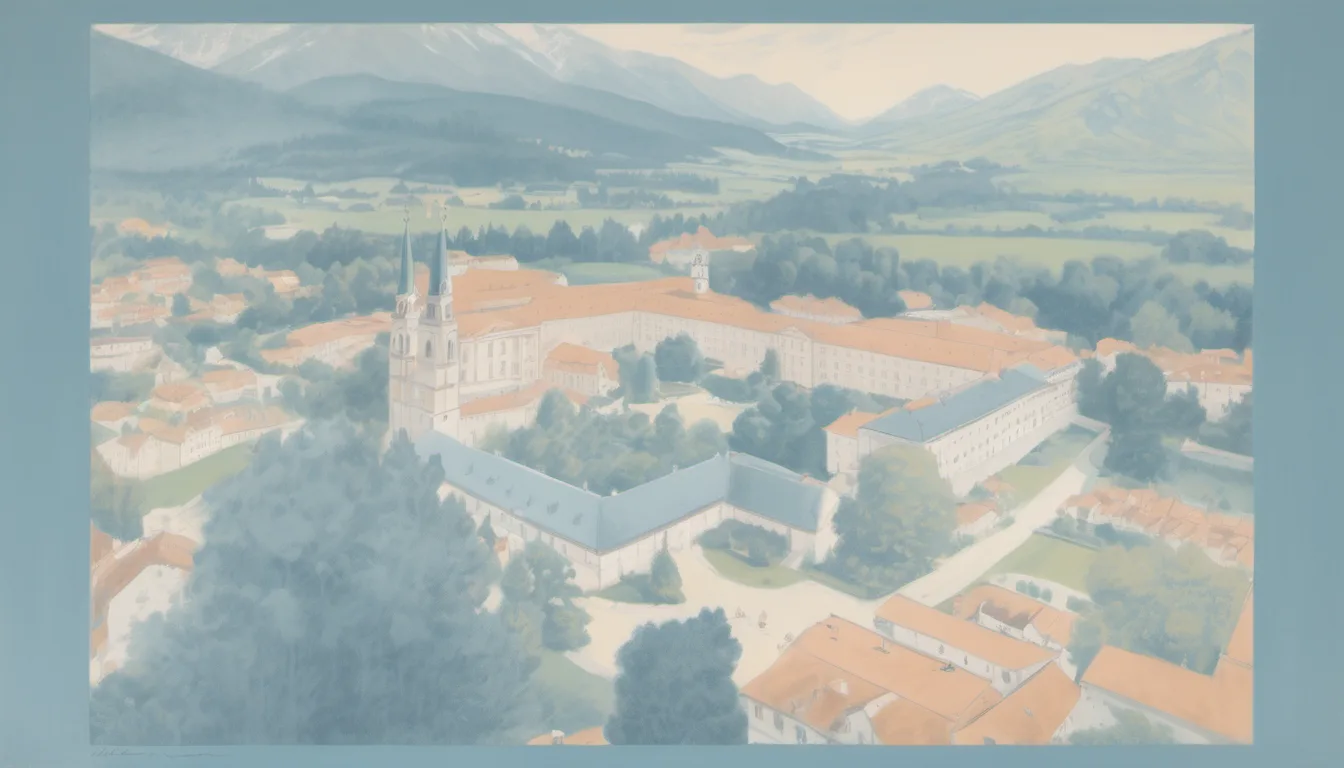
Admont does not shout. It sits quietly where the Enns River cuts through the limestone jaws of the Gesäuse National Park, a Benedictine stronghold that has watched empires rise and fall from the same stone foundations since 1074. To walk here is to step into a pause, a deliberate slowing of time that feels less like a vacation and more like a return. The town itself is modest, a collection of slate roofs and quiet streets, but it exists solely to serve the Abbey, a structure so dominant it redefines the horizon.
The Abbey is not merely a building; it is the reason for Admont’s existence. Founded by Archbishop Gebhard of Salzburg, it is the oldest remaining monastery in Styria, yet its current form is a testament to resilience. After a fire in 1865 destroyed nearly everything, the community rebuilt with a Baroque grandeur that rivals the great palaces of Vienna. But the true weight of Admont lies in its silence, a silence that is not empty, but filled with the accumulated knowledge of nine centuries.
Walking the grounds rewards you with a specific kind of clarity. You move from the heavy, marble-chilled air of the Abbey Church, with its 67-meter towers and Martino Altomonte’s frescoes, into the library hall. This is the singular thing that makes Admont matter. The library hall, designed by Joseph Hueber in 1776, is a masterpiece of spatial harmony. Seventy meters long, its seven cupolas adorned with Bartolomeo Altomonte’s frescoes, it houses 70,000 volumes. It is the largest monastic library in the world, and standing within it, you feel the sheer mass of human curiosity preserved in paper and parchment.
Beyond the library, the abbey’s scientific legacy offers a quieter, more tactile engagement. The Natural History Museum, born from the efforts of Father Gabriel Strobl after the 1865 fire, holds over 250,000 insect specimens. It is a place of meticulous order, where the chaos of nature is cataloged with Benedictine precision. Walking Admont is an exercise in attention. It asks you to look at the details—the embroidery of Brother Benno Haan, the white Carrara marble of Saint Blaise, the way the light hits the Gesäuse cliffs. It is a city that rewards the slow walker, offering depth where others offer only surface.
Admont is a study in endurance. Located on the banks of the Enns River, at the edge of the mountainous Gesäuse National Park, its name itself—derived from the Latin 'ad montes', meaning 'at the mountains'—hints at its geographical destiny. This is not a city of commerce or industry, but of contemplation. The Benedictine Abbey, founded in 1074 by Archbishop Gebhard of Salzburg on land donated by Hemma of Gurk, stands as the oldest remaining monastery in Styria. To walk through its gates is to enter a timeline that stretches back over nine centuries, a timeline marked not by the rise and fall of kings, but by the quiet, persistent accumulation of knowledge.
The early history of Admont is one of intellectual ambition. Settled by monks from St. Peter's Abbey in Salzburg under Abbot Isingrin, the community quickly established itself as a center of learning. The second abbot, Giselbert, introduced the Cluniac reforms, tightening the spiritual discipline, while another early abbot, Wolfhold, established a convent for the education of noble girls, a progressive move for the era. The educational tradition remained strong, producing notable scholars like Abbot Engelbert of Admont (1297–1327), who authored many works and elevated the abbey’s reputation. During the Middle Ages, the monastery prospered, boasting a productive scriptorium where manuscripts were copied and preserved with meticulous care.
However, history is rarely a straight line. The 16th century brought the twin disasters of the Reformation and the Ottoman Wars. The abbey entered a lengthy decline, exacerbated by internal strife. Abbot Valentine was forced to resign due to his Reformed views, a stark reminder of the religious fractures tearing through Europe. Yet, with the Counter-Reformation, the abbey found its footing again. It expanded its educational reach, offering faculties of theology and philosophy. Abbot Albert von Muchar became a renowned historian, teaching at the University of Graz, further cementing Admont’s role as an intellectual hub amidst the political turmoil of the Habsburg lands.
The 17th and 18th centuries marked a golden age of artistic productivity, transforming the abbey into the Baroque jewel it is today. This was the era of Brother Benno Haan (1631–1720), a world-famous ecclesiastical embroiderer whose intricate liturgical vestments and tapestries still grace the choir. The sculptor Josef Stammel also contributed significantly to the abbey’s visual language. The Abbey Church, designed by architect Wilhelm Bücher after the catastrophic fire of 1865, stands as a testament to this Baroque legacy. Its two west towers rise 67 meters, dominating the skyline, while the facade features figures of Saint Benedict and Saint Scholastica, and the patron, Saint Blaise, atop the west door.
The fire of April 27, 1865, was a pivotal moment. It destroyed almost the entire monastery, including the monastic archives. Yet, the library was salvaged, a stroke of luck that preserved the core of the abbey’s identity. Reconstruction began the following year, a laborious process that continued until 1890. The library hall, built in 1776 to designs by Joseph Hueber, was the heart of this preservation. Seventy meters long, 14 meters wide, and 13 meters high, it contains approximately 70,000 volumes from the monastery’s total holding of 200,000. The ceiling, divided into seven cupolas, is decorated with frescoes by Bartolomeo Altomonte, creating a sense of infinite space that seems to lift the weight of the books below.
The library is not just a repository; it is an architectural experience. With over 1,400 manuscripts and 900 incunabulae, it holds some of the most significant texts in European history. Walking through the hall, you are surrounded by the smell of old paper and the visual grandeur of the Baroque. The library’s existence is a legend of survival, a testament to the Benedictine vow of stability. It stands as the largest monastic library in the world, a fact that feels less like a statistic and more like a miracle of organization and care. It is a place where silence is not an absence, but a presence, filled with the voices of centuries past.
Beyond the library, the abbey’s scientific curiosity offers another layer to the visit. The Natural History Museum, established by Father Gabriel Strobl after the 1865 fire, began as a replacement for collections destroyed in the blaze. Strobl, a botanist and entomologist, built up an insect collection that grew to become one of the largest in Europe. The museum now holds over 250,000 insect specimens, including one of the three largest collections of flies (Diptera) in Europe. This scientific rigor, born from loss, reflects the Benedictine commitment to understanding God’s creation in all its forms. It is a quiet, dusty, fascinating world that contrasts with the gold and marble of the library.
The Abbey Church itself is a work of art, designed by Wilhelm Bücher to replace the structure lost in the fire. The interior features a central aisle and two side aisles, each opening onto five side chapels and six altars. The altar of Mary, Maria Immaculata, features a painting by Martino Altomonte (1657–1745), while the high altar is crowned by a statue of Saint Blaise in white Carrara marble. The choir is decorated with early 18th-century tapestries by Benno Haan, and the Chapel of St. Benedict houses a Baroque Corpus Christi from the workshop of Johann Meinrad Guggenbichler. Every stone and fresco tells a story of devotion and artistic excellence.
The political history of the region adds depth to the abbey’s story. Admont lies within the historical territory of the March of Styria, created in 970. The region was shaped by the Ottokar dynasty, who built the castle of Steyr and gradually expanded their influence. The abbey’s founding in 1074 coincided with this period of consolidation. The Margraves of Styria, including Ottocaro IV, who was elevated to Duke in 1180, played a crucial role in the region’s development. The Abbey of Admont was one of many monasteries founded during this era, serving as spiritual and economic anchors in a developing landscape. The connection to the Babenberg dynasty, which took over Styria in 1192, further ties the abbey to the broader narrative of Austrian history.
Today, Admont Abbey is a thriving Benedictine community, with 26 monks as of July 2025, under Abbot Gerhard Hafner. The community has returned to its roots, balancing prayer, scholarship, and engagement with the world. The abbey’s museums, library, and church are open to visitors, inviting them to experience the silence and the beauty. The proximity to Gesäuse National Park offers opportunities for hiking and nature appreciation, providing a contrast to the enclosed, intellectual world of the abbey. Walking Admont is a journey through time, from the early Middle Ages to the present, through fire and reconstruction, through war and peace. It is a place that demands respect, offering in return a profound sense of continuity and purpose.