Duomo di San Leo
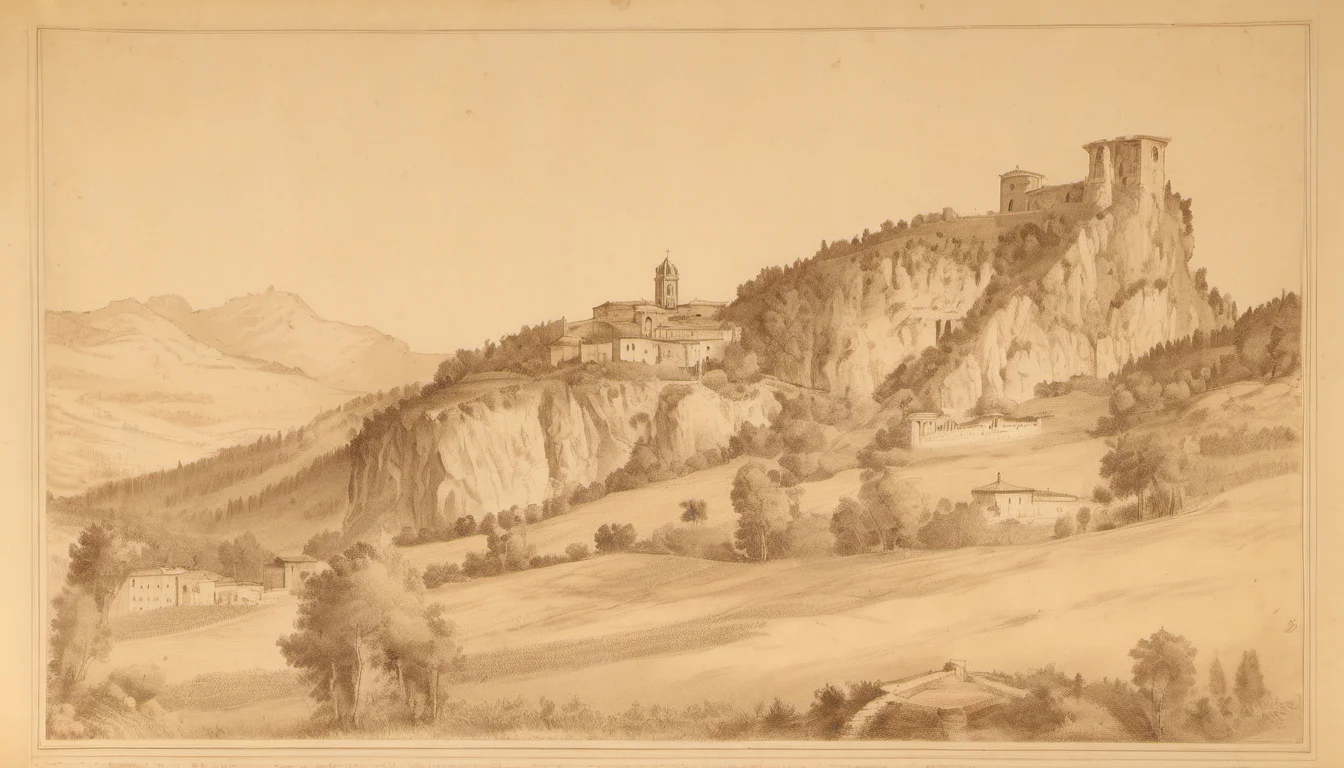
San Leo clings to a spur of rock in the Valmarecchia, a vantage over San Marino and the Marecchia valley. The Duomo stands at its heart, a Romanesque cathedral that seems to grow from the stone itself. Its origins are layered with legend.
The local cathedral preserves two ancient columns and two capitals, which some scholars link to a temple of Jupiter Feretrius. Others argue for an Umbrian pre-Roman presence. The truth rests between the lines of history. What is certain is the weight of centuries in these stones.
The town's name shifted from Mons Feretri to San Leo, after a Dalmatian hermit who accompanied Saint Marinus. The cathedral became the spiritual anchor of the Montefeltro region. Today, it remains a quiet, almost private place, where the only crowds are the shadows of the past.
To stand before the Duomo is to grasp the geology and faith of this land. The rock spur dictates the layout; the cathedral follows. Inside, the columns are the main draw – and the main puzzle. No signage explains them. You are left to wonder.
San Leo is not a town you stumble upon. It sits on a spur of rock in the Valmarecchia, a limestone finger pointing toward San Marino and the Marecchia valley. The road winds up, the view opens, and then you see it: the Duomo, a Romanesque cathedral planted on the edge of the precipice. It is not grand in the way of urban cathedrals. It is severe, compact, made for a community that needed both God and a fortress.
The cathedral's most intriguing features are two Roman columns and two capitals, now built into its fabric. The source text notes that some scholars derive the ancient toponym 'Mons Feretri' from a temple of Jupiter Feretrius, citing these columns as evidence. Others propose an Umbrian origin, suggesting the rock was already sacred before Rome. Neither theory is proved. What is visible is the stonework itself: weathered, unlabeled, inviting speculation. The columns are not displayed as artifacts; they are simply there, holding up the faith.
The name 'Feretri' was later Christianized to 'Feltro', giving the region Montefeltro. But the town itself took the name San Leo from a Dalmatian hermit, companion of Saint Marinus, who lived on this rock in the early Christian centuries. The cathedral, then, is a palimpsest: a Christian church built on an older sacred site, its masonry incorporating the bones of a forgotten cult.
The geography defines everything. The cathedral is built on the highest point of the spur, its apse nearly hanging over the void. Inside, the space is sober, with a single nave and a wooden roof. Light enters through small windows, falling on the ancient columns. There is no bombastic Neoclassical redecoration here, no Bernini baldacchino. The power is in the raw stone and the view from the door.
The cathedral also serves as a repository of local history. The Bishop of Montefeltro once held his seat here. The rock itself was the nucleus of a vast territory. To walk the square outside the Duomo is to feel the weight of that jurisdiction, even if the details have faded into legend.
Legends cluster around the two columns. Some say they came from a temple of Jupiter Feretrius, built on this very spot by Romans who recognized the strategic ridge. Others, more cautious, point out that such a temple is far more likely in Rome itself, and that the columns may have been salvaged from a nearby villa or a smaller shrine. The truth is not recorded. The capitals, carved with simple volutes, offer no answers. They remain a quiet mystery.
What is not in dispute is the beauty of the setting. From the cathedral square, the eye travels across the Marecchia valley to San Marino, a republic on another mountain. The rock spur drops away sheer on three sides. The Duomo seems to float. It is a place for lingering, for watching the light change on the distant hills.
The town of San Leo today has fewer than three thousand inhabitants. The Duomo is not a pilgrimage destination in the modern sense. There are no souvenir stalls, no audio guides. The visitor comes to be alone with the stone and the story. The columns, the legend, the view: that is enough.