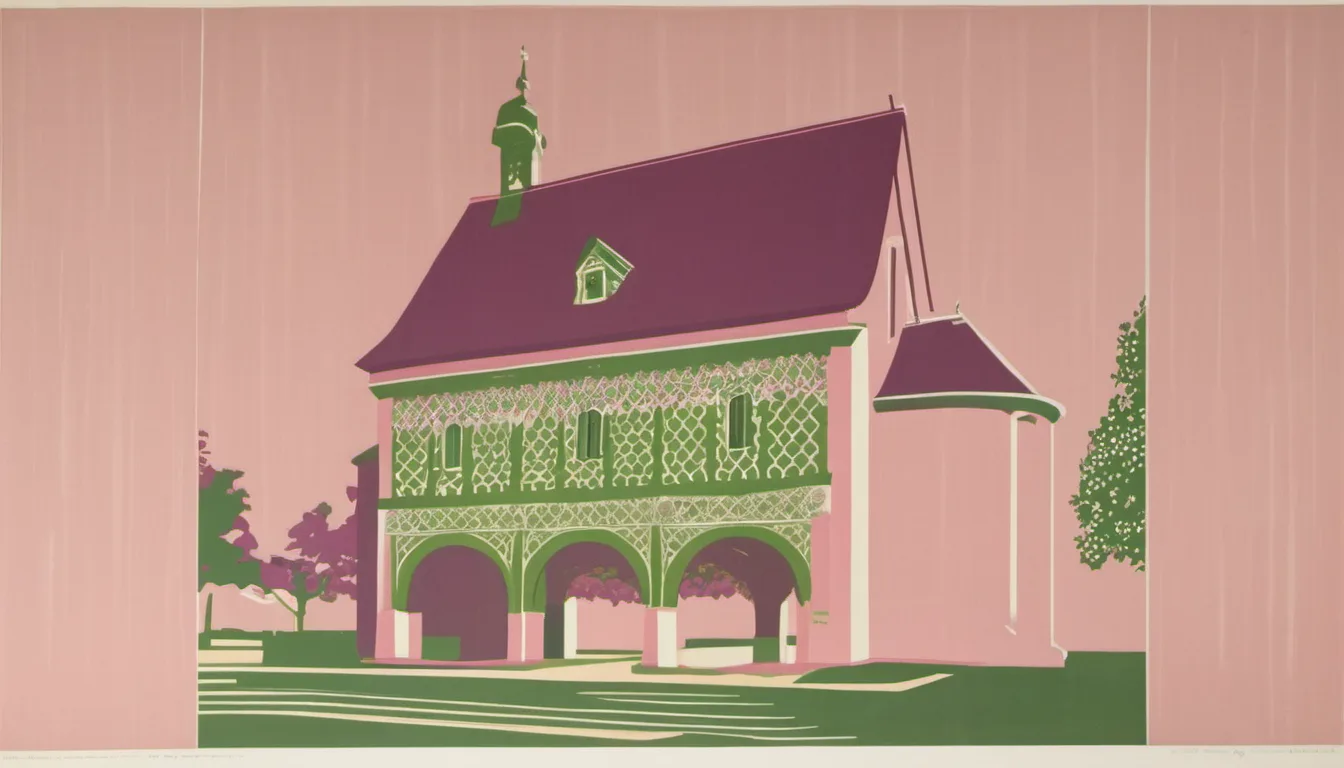
Lorsch, Germany
Lorsch sits quietly in the Rhine rift, five kilometers west of the famous Bergstraße, nestled between the Odenwald hills and the flatlands. It is not a city that shouts for attention, but one that holds its ground with the weight of centuries. The town is defined by the presence of Lorsch Abbey, a site so significant it earned UNESCO World Heritage status in 1991. To walk here is to walk through the layers of German history, from the Frankish counts who laid the first stones to the modern administrative structures that now manage the town.
The heart of the visit is the gatehall, or Königshalle, dating from around 800. This structure is a rare surviving fragment of a once-mighty Imperial monastery. It stands as a testament to Carolingian art and architecture, a period when Lorsch was a central power in the region. The building’s sturdy stone walls speak of a time when the abbey held vast holdings across the Odenwald, Rhenish Hesse, Alsace, and Lorraine. Today, it is a protected symbol of that early medieval grandeur.
Beyond the gatehall, the town offers a glimpse into the daily life of a Hessian community. The town hall, built between 1714 and 1715, now houses the Tourist Information and Adult Education Center. Nearby, the oldest timber-frame house at Stiftstraße 19 and the Weißes Kreuz, the town’s oldest guesthouse, offer architectural contrasts that span centuries. These structures are not merely relics but living parts of the town’s fabric.
Walking through Lorsch rewards those who look closely. The Benedictine herb gardens at the abbey provide a sensory connection to the past, while the Weschnitzinsel conservation area to the southeast offers natural respite. The town’s history is not just in its stones but in its name, derived from Lauressam, recorded in 885. It is a place where the political struggles of the Investiture Controversy and the subsequent transfer to the Archbishopric of Mainz are etched into the landscape. Lorsch is a study in endurance and quiet dignity.
Lorsch is a town defined by its relationship with power, both secular and sacred. Located in the Bergstraße district of Hesse, roughly 60 kilometers south of Frankfurt, it occupies a strategic position in the Rhine rift. The town lies west of the Odenwald, between Darmstadt and Mannheim, and close to the lower reaches of the Weschnitz river. This geography has always made it a node of importance, a place where trade, religion, and politics intersect. Today, it is best known for Lorsch Abbey, a World Heritage Site that anchors the town’s identity and draws visitors interested in the deep roots of European history.
The story of Lorsch begins in 764, when Frankish Count Cancor and his mother Williswinda founded the abbey. It was settled by Benedictines from Gorze Abbey near Metz, quickly establishing itself as one of the greatest centers of Carolingian art. The abbey’s influence grew rapidly, becoming a powerful Imperial monastery with holdings stretching across the nearby Odenwald, the Bergstraße, Rhenish Hesse, and even into Alsace and Lorraine. Several Carolingian kings of Germany were buried here, a testament to the abbey’s prestige and political weight during the Early and High Middle Ages.
The name Lorsch itself is a linguistic fossil, derived from Lauressam, a term recorded in a document from 885. Over centuries, this evolved into the modern name. The abbey’s prominence was not without conflict. During the Investiture Controversy in the 11th century, a civil war erupted, and the abbey suffered significant losses of its holdings to local nobility. This period marked a decline in its temporal power, though its spiritual and cultural significance remained undiminished. The struggle for control over the abbey’s assets was a microcosm of the broader power struggles within the Holy Roman Empire.
In the late 12th century, an attempt was made to reorganize the abbey’s administration, resulting in the creation of the Lorsch Codex, a record of old deeds that remains a crucial historical document. However, by 1232, Lorsch was awarded to the Archbishopric of Mainz. The monastery was then settled by Premonstratensians, marking a new chapter in its religious life. This transfer sparked further disputes, as Mainz and the Electorate of the Palatinate clashed over who should hold the vogt rights. These political entanglements shaped the town’s development, embedding it firmly within the ecclesiastical and secular power structures of the region.
Of the vast Carolingian Benedictine complex, only the gatehall, or Königshalle, has survived from around 800. This structure is a masterpiece of early medieval architecture, preserved today as a UNESCO World Heritage Site. The gatehall stands as a silent witness to the abbey’s former glory, its sturdy walls and precise stonework reflecting the artistic and engineering capabilities of the Carolingian era. It is not merely a ruin but a preserved monument, offering a tangible connection to the past that is rare in Europe.
The town’s coat of arms reflects this history. It features the King’s Hall, the building declared a UNESCO World Heritage Site in 1991, borne as a charge. Below, a red cross pattée fitchy represents the coat of arms formerly borne by the Lorsch Abbey in its heyday. The Lion of Hesse, shown springing, symbolizes Lorsch’s status as part of Hesse. These symbols are not just decorative; they are a visual summary of the town’s complex identity, blending imperial, ecclesiastical, and regional affiliations.
Beyond the abbey, Lorsch offers a variety of cultural and historical sites. The Museumszentrum Lorsch houses departments dedicated to monastic history and folklore, as well as a tobacco museum. The Freilichtlabor Lauresham, an open-air museum, opened in 2014/5, providing further insights into the town’s past. The town hall, built between 1714 and 1715, now serves as the location for the Tourist Information and the Adult Education Center. Lorsch’s oldest timber-frame house at Stiftstraße 19 and the Weißes Kreuz, the town’s oldest guesthouse, add to the architectural tapestry.
The town’s cultural life is vibrant, with regular events such as the Fastnacht, or Carnival, parade on Tuesday, featuring more than 100 attractions. The Kleinkunstbühne Sapperlot offers cabaret, while the Musiktheater Rex provides musical theater. These institutions contribute to a lively cultural scene that contrasts with the town’s historical solemnity. The town’s infrastructure, including the DB railway station on the Nibelungenbahn and connections via bus, makes it accessible to visitors from nearby cities like Bensheim, Heppenheim, and Mannheim.
Lorsch’s modern identity is also shaped by its notable people and institutions. The town has produced honorary citizens like Friedrich Behn, an archaeologist, and Albert Ohlmeyer, an abbot. It is the birthplace of CDU politician Michael Meister and opera singer Ernst-Dieter Suttheimer. The town is also home to TrekStor GmbH & Co.KG, a firm founded in 2001, reflecting its engagement with modern industry. The educational landscape includes the Wingertsbergschule, a primary school founded in 1974, and the Werner-von-Siemens Schule, a Hauptschule-Realschule named after the Berlin inventor.
The town’s twinning arrangements with Le Coteau in France, Zwevegem in Belgium, and Thal in Thuringia, along with a friendship arrangement with Šternberk in the Czech Republic, highlight its international connections. These relationships, often rooted in historical sponsorship for ethnic Germans driven out of communities like Jívová and Pohorsch, underscore Lorsch’s role in broader European networks. The town’s history is not isolated but part of a wider tapestry of migration, settlement, and cultural exchange.
To walk through Lorsch is to engage with a place where history is not just remembered but lived. The gatehall stands as a sentinel over the town, its stone walls echoing with the footsteps of kings and monks. The herb gardens offer a sensory journey through time, while the town’s buildings tell stories of architectural evolution. Lorsch is a city that rewards the curious walker, offering layers of meaning in every stone and street. It is a place where the past is present, and the present is built upon the foundations of the past.