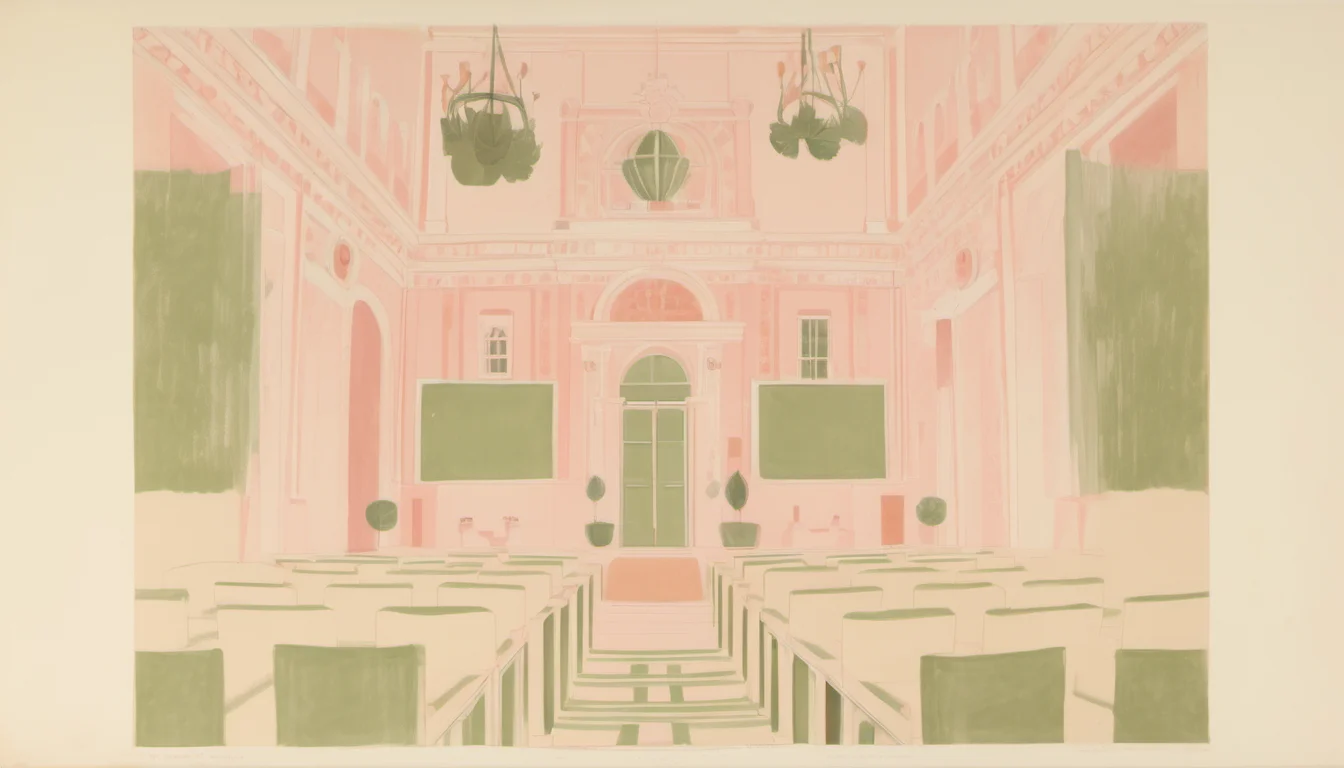
Macerata, Italy
Macerata is not the kind of place that announces itself. There is no volcanic black rock, no Byzantine gold, no single masterpiece that made the cover of a book. It sits on a low hill between two river valleys, the last town before the Apennines climb into the Sibillini, and it has been here long enough not to need your attention. Red rooftops climbing toward the centre. A university that has been teaching law and theology since 1290. A long straight main street called Corso della Repubblica that runs from one end to the other in twenty minutes. You walk it and think you have seen everything. You have not. That is the trick: it opens up as you go.
What matters is the Sferisterio. Pale Istrian stone, a straight wall 180 metres long, built between 1820 and 1829 for a game called palla al bracciale. Imagine handball, but with a spiked wooden bracelet strapped to the forearm and a leather ball that could break your fingers. The players were celebrities. The game was brutally fast. And by the 1920s it was dead. Football killed it. The arena sat empty for forty years.
In 1967 a local music teacher named Domenico Carini persuaded the city to let him try something else. They built a stage across the straight wall, bolted seats into the old hemicycles, and put on Aida. The acoustics surprised everyone. The open stone bowl does something to sound that no roofed theatre can match. It reflects and warms it. The first season was a local gamble. By the 1990s people were flying in from Tokyo.
Tonight the tier lights glow amber. The sky above is dark blue. The stage is 70 metres wide, wider than La Scala. There is no amplification. When the soprano hits the high note in the second act, the stone carries it to every seat. You can hear her breathe. You came for the singing. You will leave remembering the space.
Macerata was founded, according to the story the town tells, by refugees from the Picenum region in the 6th century. They were fleeing the Gothic Wars, the same conflict that turned Urbino into a Byzantine stronghold, and they found a defensible hill surrounded by river plains, far enough inland to be safe from the Adriatic pirates who raided the coast. By the Middle Ages it was a free commune, then a podesta, then the Papal States absorbed it. The university, founded in 1290 by papal bull, is the second oldest in the Marche after Camerino. Law and theology mostly. The kind of quiet institution that produces bishops and notaries, not revolutions.
The Sferisterio changed that. It was the work of Ireneo Aleandri, a neoclassical architect who had studied in Rome under Giuseppe Valadier. He was thirty-three when he started, and it is his best work by a margin. A semi-ellipse of Istrian stone and brick, 180 metres along the major axis. The facade is severe: two storeys of blind arcades, Doric below, Ionic above, no ornament beyond the stone itself. It looks like a Roman aqueduct drawn by someone who wished he had built one.
The game it was built for, palla al bracciale, was fast and brutal. Two teams of three on a long narrow court. A leather ball with a rubber core. The bracciale was a cylinder of wood studded with lead spikes, strapped to the forearm. Players hit the ball at speeds that broke bones. The best players were national celebrities: men like Ruggero Tita and Giovanni Pastina, whose names still appear in sports histories. But by 1910 it was in decline. Too violent for a public that had discovered calcio. The last recorded professional match was in the 1920s.
For forty years the arena hosted cycling races, boxing matches, political rallies. Mussolini spoke here in 1934. In 1950 an American circus brought an elephant onto the arena floor. The city council decided that was a step too far. They closed it for structural assessments. It might have been demolished. The stone was sound but the purpose was gone.
The revival came from Domenico Carini, a local music teacher who had spent the war years dreaming about opera in the arena. He persuaded the council to let him try one production. He raised the money himself. Aida, July 1967, directed by Franco Zeffirelli's assistant, with a young tenor from Parma named Giuseppe Campora. It worked. The next year, three operas. By 1970 it was a festival.
What makes the acoustics work is the stone. Istrian stone is dense, slightly porous. The curved seating catches the voice and bounces it outward with natural reverb. No electrical amplification. When a singer hits a high note in Tosca, the tone fills the arena completely. You can hear it from the back row on the far side. The designers of the game court never intended this. They built a shape that turned out to be perfect for the human voice.
Macerata is not Urbino. It has no single genius patron, no Piero della Francesca frescoes, no perfect Renaissance ideal. What it has is quieter continuity. The university keeps young people in the streets. The Sferisterio brings foreigners in the summer. The rest of the year it is a market town for the surrounding farmland: wheat, sunflowers, vineyards, truffle oaks. The walk is easy. The food is good. The opera is the best open-air staging in Italy that is not Verona, and the crowd is a tenth the size. You can hear the singers breathe.
Do not miss around Macerata
2 placesEvery place below is a ten-to-fifteen minute walk from the last.