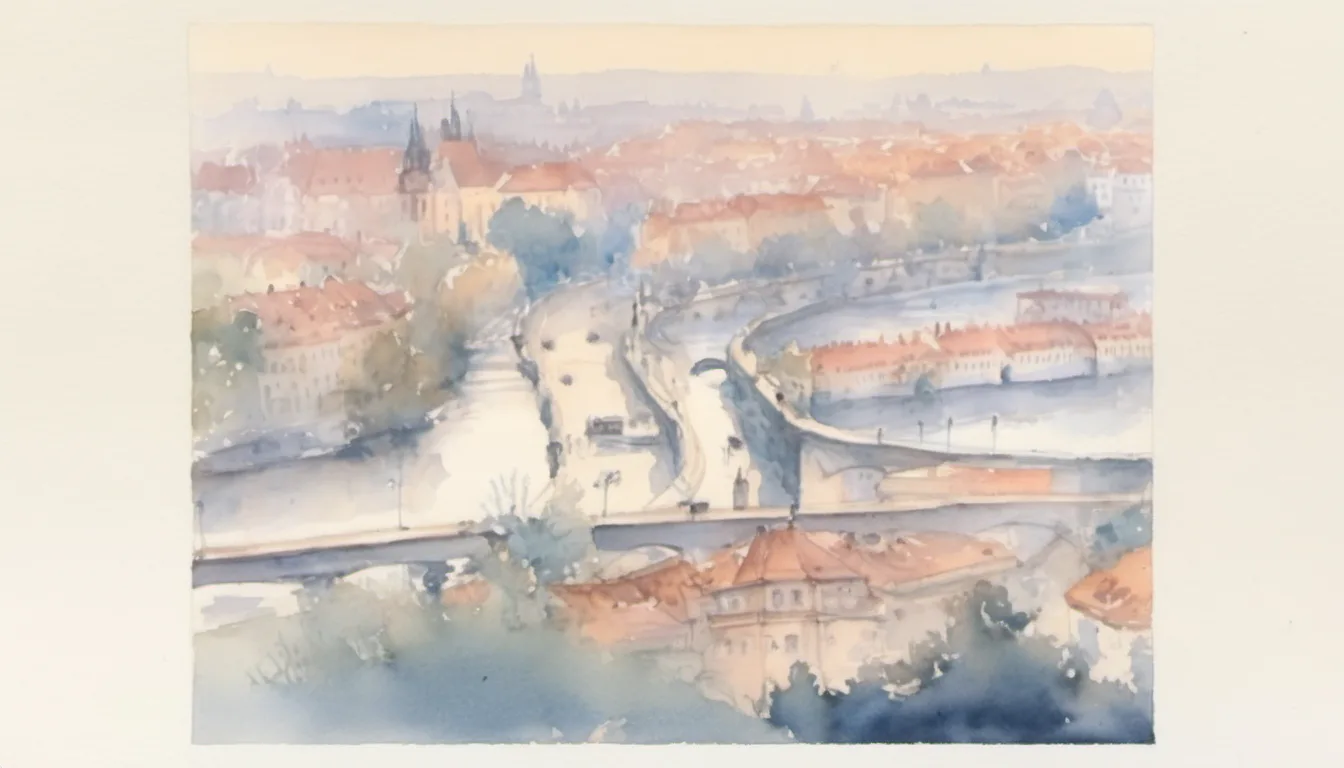
Prague, Czechia
Prague does not announce itself with fanfare; it reveals itself in layers of stone, river mist, and the quiet persistence of history. Located on the Vltava, this capital of Bohemia is a city where the past is not merely preserved but inhabited. With a population of 1.4 million, it moves with the measured rhythm of a place that has seen empires rise and fall, yet remains stubbornly, beautifully intact. It is a city of thresholds, both literal and metaphorical.
The city’s essence lies in its verticality and its river. From the heights of Prague Castle, looking down over the red-tiled roofs and the winding Vltava, one understands why it was called the City of a Hundred Spires—a title now updated to five hundred. This is not a city of skyscrapers but of spires, towers, and steeples, each telling a story of faith, power, and survival. The Golden City, as it is also known, glows with an ochre warmth that changes with the light, from the cold grey of winter to the golden haze of late afternoon.
Walking Prague is an exercise in reading the ground beneath your feet. The cobblestones of the Old Town, the narrow alleys of Malá Strana, and the wide boulevards of Nové Město are not just paths but pages in a continuous narrative. You walk through the site of a burned forest, as the name Praha suggests, or over the ford of the Vltava, as the older legend claims. Every step connects you to the Celtic oppidum of Závist, the Germanic settlements, and the Slavic tribes that settled here centuries ago. The city is a palimpsest, written over and over, yet always legible.
What makes Prague matter is its resilience. It has been a seat of dukes, kings, Holy Roman Emperors, and post-war presidents. It has survived the Plague, the Thirty Years' War, the Nazi occupation, and the Communist era. Yet, it remains a place of art, music, and intellectual ferment. Charles University, founded in 1347, still teaches in the same halls. The Astronomical Clock still ticks. The Jewish Quarter still prays. To walk here is to walk through time, not as a tourist, but as a participant in a story that refuses to end.
Prague is a city that demands to be read, not just seen. Its history is not confined to museums but is embedded in the very fabric of its streets, buildings, and river. From the Paleolithic settlements to the modern capital of the Czech Republic, Prague has been a crossroads of cultures, religions, and empires. It is a place where the Romanesque, Gothic, Renaissance, and Baroque styles coexist, creating a visual language that is uniquely its own. To walk through Prague is to walk through the history of Europe itself.
The origins of Prague are shrouded in legend and archaeology. According to the Chronica Boemorum, written by Cosmas of Prague in the 12th century, the city was founded by the prophetess Libuše, who prophesied from Vyšehrad: "I see a great city whose glory will touch the stars." While archaeologists point to Celtic settlements like Závist and Germanic tribes like the Marcomanni, the name Praha itself is a subject of debate. Some derive it from the Slavic word for 'ford,' referring to the crossing of the Vltava. Others, like 19th-century linguist Antonín Profous, suggest it comes from 'pražiti,' meaning 'to burn,' referencing the burned forest used to clear land for settlement. Or perhaps it refers to the hot, arid shale bedrock upon which the castle stands.
The physical growth of Prague mirrors its political ascendancy. Starting with the fortified settlement of Prague Castle around 885 and the fort of Vyšehrad in the 10th century, the city expanded to become the seat of the Přemyslid dynasty. Under Duke Boleslaus II, it became a bishopric in 973, and later, under Charles IV, it became the capital of the Holy Roman Empire. Charles IV, who reigned from 1346 to 1378, transformed Prague into an imperial capital, founding Charles University in 1347, the oldest in Central Europe, and commissioning the New Town (Nové Město). He also began the construction of Saint Vitus Cathedral, which would not be completed until the 20th century, a testament to the enduring ambition of the city.
The 14th century was a period of immense prosperity and turbulence. Prague’s population grew to around 70,000, making it one of the largest cities in the Holy Roman Empire. It was a center of trade, attracting German and Italian bankers and merchants. The social order, however, was strained by the rising power of craft guilds and increasing poverty. The Hunger Wall, built in the 1360s south of Malá Strana, was a fortification constructed during a famine, reportedly ordered by Charles IV to provide employment and food for the workers. This blend of charity and control is characteristic of the city’s history.
The city’s religious and political struggles defined its next centuries. The Bohemian Reformation, led by Jan Hus, challenged the authority of the Catholic Church, leading to the Hussite Wars. The Defenestration of Prague in 1618, where Protestant nobles threw imperial officials from a castle window, sparked the Thirty Years' War, devastating the city. Under the Habsburgs, Prague became a secondary capital, but it retained its cultural significance. The Baroque era left an indelible mark, with churches, palaces, and statues adorning the cityscape, reflecting the Counter-Reformation’s emphasis on grandeur and emotion.
The 18th and 19th centuries saw Prague’s revival. The Enlightenment brought new ideas, and the National Revival sought to reclaim Czech identity. The city’s population grew, and the industrial revolution brought changes. The Jewish community, one of the oldest in the world, played a significant role in the city’s economic and cultural life. The Old New Synagogue, dating back to 1270, still stands, a silent witness to centuries of Jewish life, persecution, and resilience. The Jewish Quarter, or Josefov, is a poignant reminder of the city’s complex history.
The 20th century was a period of upheaval and transformation. Prague became the capital of Czechoslovakia after World War I, experiencing a cultural golden age. The interwar period was marked by political instability and the rise of totalitarianism. The Nazi occupation during World War II led to the destruction of much of the Jewish community and the suppression of Czech culture. The Communist era, following the 1948 coup, brought censorship, economic stagnation, and the suppression of dissent. Yet, Prague remained a center of intellectual and artistic resistance.
The Velvet Revolution of 1989, led by Václav Havel and others, peacefully ended Communist rule and restored democracy. This event marked a new chapter for Prague, integrating it into the European Union and the global community. The city’s historic center, recognized as a UNESCO World Heritage Site in 1992, has been meticulously preserved, attracting millions of visitors annually. Today, Prague is a Beta+ global city, known for its rich history, cultural attractions, and vibrant modern life.
Walking through Prague today is an experience of contrasts. The bustling tourist areas of the Old Town Square, with its Astronomical Clock and Týn Church, contrast with the quiet, narrow streets of Malá Strana. The grand boulevards of Nové Město, with their Art Nouveau buildings, offer a different perspective from the medieval alleys of the Jewish Quarter. The city’s architecture, from the Romanesque rotundas to the Gothic spires of Saint Vitus, the Renaissance courtyards of the Royal Palace, and the Baroque domes of St. Nicholas Church, tells a story of artistic evolution and cultural exchange.
The Vltava River remains the city’s lifeline, connecting the disparate parts of Prague. The Charles Bridge, built in the 14th century to replace the Judith Bridge, is not just a crossing but a symbol of the city’s endurance. Lined with statues of saints and saints, it offers panoramic views of the castle and the river. The Petřín Hill, with its lookout tower inspired by the Eiffel Tower, provides a vantage point for appreciating the city’s layout and beauty. The Vyšehrad, the older fort, offers a quieter, more contemplative experience, with its cemetery where Czech cultural icons are buried.
Prague is a city that rewards the curious walker. It is not just about seeing the sights but about understanding the layers of history, the interplay of cultures, and the resilience of its people. From the legend of Libuše to the reality of modern democracy, Prague is a city that has shaped and been shaped by the forces of history. To walk through Prague is to walk through time, to feel the weight of centuries, and to appreciate the beauty of a city that has survived, adapted, and thrived.