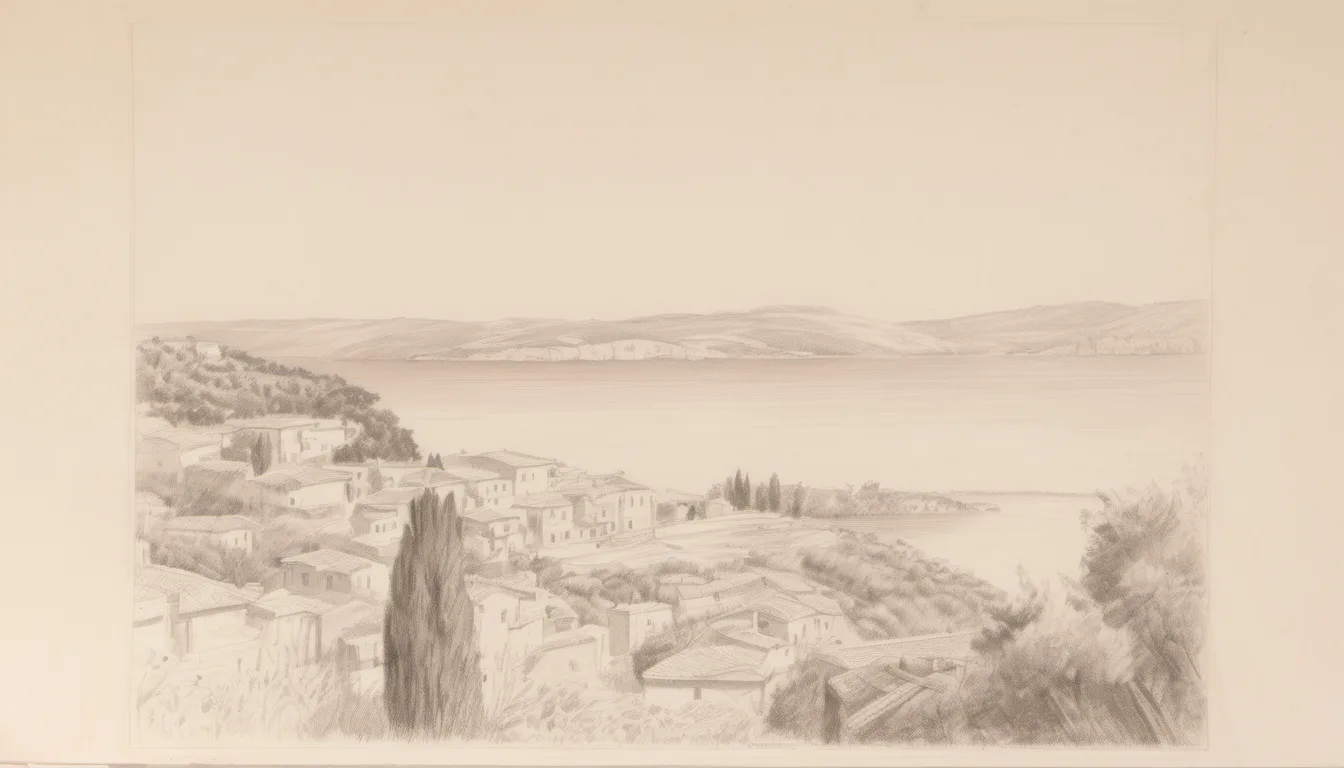
Pylos, Greece
Pylos does not announce itself. It sits quietly on the Bay of Navarino, a small town of fewer than three thousand souls, defined less by its own scale than by the weight of the history it holds. To walk here is to move through layers of time, where the modern harbor’s daily rhythm overlaps with the silence of the Mycenaean past. The town is not a museum; it is a living place, yet one that breathes differently than the busier resorts of the Peloponnese.
The city’s significance lies in its dual identity. Above, on the hill of Ano Englianos, lies the Palace of Nestor, the best-preserved Mycenaean palace in Greece. Below, the current town of Pylos was built in the 1820s by French military engineers after the Battle of Navarino. This juxtaposition is unique: you can walk from the site of a 19th-century naval battle to the administrative heart of a Bronze Age kingdom in a single afternoon. The town serves as the quiet gateway to these deep histories.
Walking Pylos rewards those who look beyond the waterfront. The streets are narrow and shaded, leading away from the marina toward the old fortress walls. Here, the air is thick with the scent of salt and pine. The town’s layout, dictated by its military origins, offers a grid that is easy to navigate but rich in detail. You will find small squares, local bakeries, and the lingering presence of the Ottoman and Venetian eras in the stonework of the buildings.
The true value of Pylos is its stillness. Unlike the crowded archaeological sites elsewhere, the modern town allows for a contemplative pace. You can sit by the water, watching the boats, and then walk up to the palace ruins to see the Linear B tablets’ origin point. It is a place for slow observation, where the past is not a distant concept but a physical presence in the landscape. The town matters because it preserves the memory of the land without overwhelming the visitor with spectacle.
To walk Pylos is to understand the Peloponnese’s complex soul. It is a place of transitions—from Mycenaean to Frankish, from Ottoman to modern Greek. The town’s small size invites curiosity. You are encouraged to explore the alleys, to find the hidden courtyards, and to listen to the stories embedded in the stone. It is a walk that demands patience but offers a profound sense of connection to the layers of human history that have shaped this corner of Greece.
Pylos, historically known as Navarino, is a town of quiet contradictions. With a population of just 2,568, it sits on the Bay of Navarino in Messenia, Peloponnese, Greece. It is the main harbor of the region, yet it lacks the bustling energy of larger ports. Since the 2011 local government reform, it has been the seat of the municipality Pylos-Nestoras. The town’s history is not merely a backdrop; it is the foundation of its identity. From Neolithic settlements to Mycenaean kingdoms, from Frankish castles to Ottoman fortresses, Pylos has been a strategic point of contact and conflict for millennia.
The region’s habitation dates back to the Neolithic period, around 6500 BC, when populations from Anatolia brought agriculture to the Balkans. Excavations at Voidokilia and Nestor’s cave have revealed painted ceramics and engraved pottery, showing a continuous human presence. By the Bronze Age, Pylos had become the capital of one of the most powerful Mycenaean kingdoms. This was not a small settlement but a state covering 2,000 square kilometers, with a population estimated between 50,000 and 120,000. The urban center, however, remains partially identified, with the Palace of Nestor serving as the primary reference point.
The Palace of Nestor, located on the hill of Ano Engliano, 9 kilometers northeast of the modern town, is the best-preserved Mycenaean palace in Greece. Discovered in 1939 by Carl Blegen and Konstantinos Kourouniotis, the palace was excavated until 1966. It features a throne room, frescoes of Minoan inspiration, large warehouses, and unique baths. The palace’s layout includes a megaron, anterooms, and passageways, all covered in vibrant frescoes. The site also includes a beehive tholos tomb, restored in 1957, which lies 90 meters from the palace. These architectural elements speak to a sophisticated administrative and cultural center.
The discovery of Linear B tablets at Pylos revolutionized the understanding of ancient Greek. Over 1,000 clay tablets were found, inscribed with a syllabic script used between 1425 and 1200 BC. These tablets, used for administrative and economic records, confirmed that the site was called Pylos (Pulos) by its Mycenaean inhabitants. The decipherment of Linear B by Michael Ventris and John Chadwick in 1952 revealed Mycenaean Greek as the earliest attested form of Greek, linking the tablets to the oral traditions of Homer. This connection places Pylos at the center of the Homeric epics, where Nestor, the king of Pylos, is depicted as a wise and respected figure.
After the collapse of the Mycenaean civilization, Pylos entered a period of obscurity. The site was uninhabited during Classical times, though it became the location of the Battle of Pylos in 425 BC during the Peloponnesian War. The site remained largely forgotten until the 13th century, when it became part of the Frankish Principality of Achaea. The Franks built the Old Navarino Castle on the site, and the town became known by its French name, Port-de-Jonc, or its Italian name, Navarino. The name Navarino likely derives from a Slavic term meaning 'place of maples,' though traditional etymologies have linked it to the Navarrese Company, a misconception that has persisted in some historical accounts.
The town’s control shifted frequently between Venice, the Ottoman Empire, and other powers. Venice controlled Pylos from 1417 to 1500, when the Ottomans conquered it. The Ottomans used the bay as a naval base and built the New Navarino Fortress in 1571/2. The area remained under Ottoman control, with brief periods of Venetian rule (1685–1715) and Russian occupation (1770–71). The town’s name evolved through these changes, with the Turkish name Anavarin and the Greek names Neokastro (new castle) and Palaiokastro (old castle) reflecting the dual fortress system.
The Greek War of Independence in 1821 brought significant changes. Ibrahim Pasha of Egypt recovered the town for the Ottomans in 1825, but the defeat of the Turco-Egyptian fleet in the 1827 Battle of Navarino forced his withdrawal. The French military intervention of the 1828 Morea expedition confirmed Greek independence. The current city of Pylos was built outside the fortress walls by French military engineers starting in 1829. The name Pylos was revived by royal decree in 1833, merging the ancient, medieval, and modern identities of the place.
The modern town of Pylos is a result of this 19th-century reconstruction. It was designed by French engineers, reflecting a military grid that contrasts with the organic growth of older Mediterranean towns. The town’s layout is practical, with narrow streets and shaded squares. It serves as the administrative center of the Pylos-Nestoras municipality, which covers 143.911 square kilometers. The municipal unit includes nearby villages such as Gialova, Pyla, and Elaiofyto, but Pylos itself remains the focal point of the region’s cultural and historical narrative.
Walking through Pylos today, one encounters the tangible remnants of its layered history. The Old Navarino Castle and the New Navarino Fortress stand as testaments to the town’s strategic importance. The Palace of Nestor, though 9 kilometers away, is an integral part of the town’s identity. Visitors can explore the palace’s ruins, including the throne room and Linear B archives, and then return to the town to experience its modern life. The contrast between the ancient ruins and the contemporary harbor creates a unique atmosphere of continuity and change.
The town’s cultural heritage is also evident in its local traditions and cuisine. The proximity to the sea has always influenced the local diet, with fresh fish and seafood being staples. The town’s small size fosters a sense of community, where locals are often eager to share stories about the area’s history. The presence of French and Italian influences in the architecture and place names reflects the town’s complex past. This blend of cultures is a defining feature of Pylos, making it a singular destination for those interested in history and archaeology.
In conclusion, Pylos is a town that invites slow, thoughtful exploration. Its history is not confined to museums but is embedded in the landscape, from the Neolithic settlements to the Mycenaean palace and the 19th-century town. The town’s small size and quiet atmosphere allow for a deep engagement with its past. Whether walking the harbor, visiting the palace, or exploring the fortress, one gains a profound appreciation for the layers of history that have shaped this corner of the Peloponnese. Pylos is not just a place on a map; it is a living archive of human civilization.