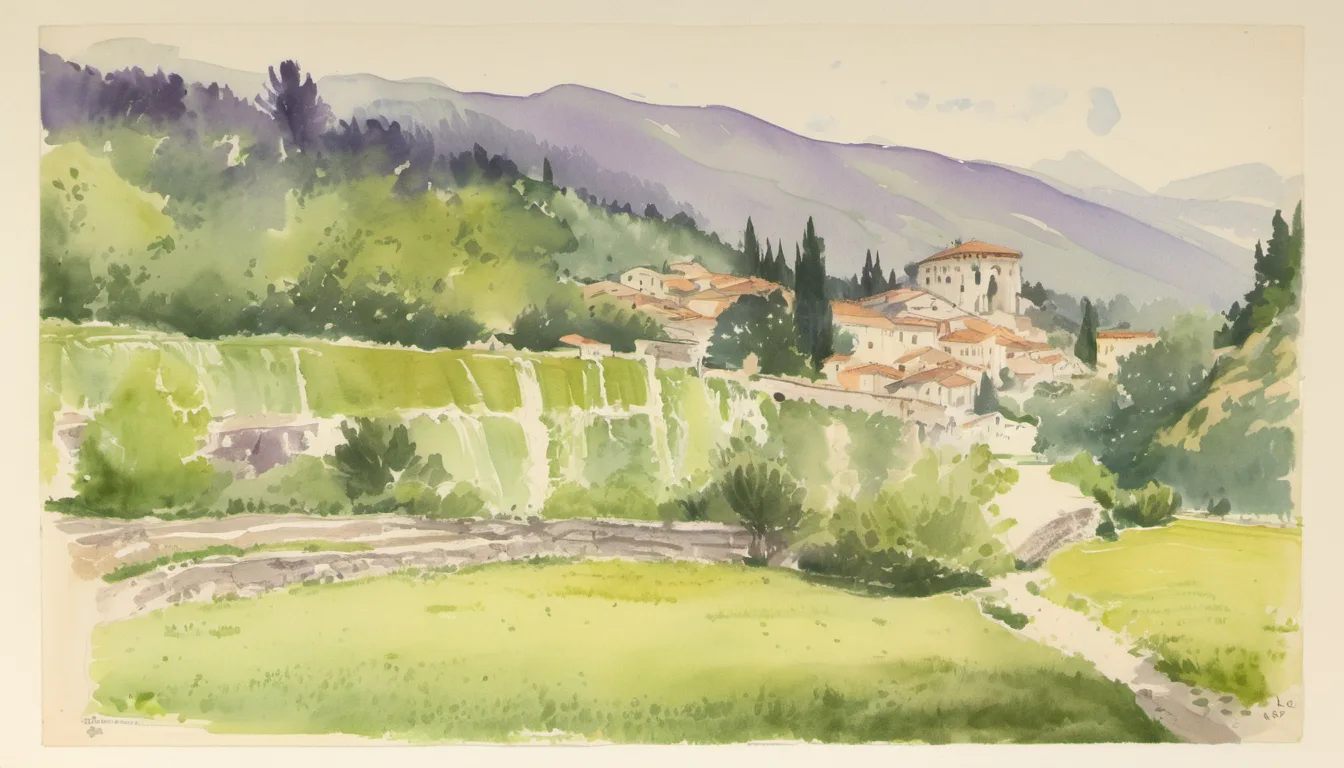
Ascoli Piceno, Italy
Ascoli Piceno does not shout. It stands. Built almost entirely of local travertine, the city glows with a pale, honeyed warmth that shifts with the hour. It is a place where stone is not merely a material but a memory, laid down by centuries of hands that understood the weight of permanence. To walk here is to move through a sculpture garden that breathes, where every arch, every tower, and every square has been shaped by the same stubborn geology.
The heart of this stone city is the Piazza del Popolo, a Renaissance square that feels less like a public space and more like a stage set by architects who knew exactly how light falls in the Marche. Surrounding it are buildings that seem to grow from the earth, their facades carved with such precision that the stone appears soft. This is not a city of grand gestures, but of refined details. The Loggia dei Mercanti, with its Bramantesque elegance, and the Cathedral of Sant'Emidio, housing a Crivelli altarpiece, speak of a time when civic pride was measured in marble and faith.
But the true singular quality of Ascoli lies in its verticality. In the Middle Ages, two hundred towers pierced the skyline, each a symbol of a powerful family. Today, fifty remain, standing like sentinels over the narrow streets. They are not museums; they are homes, offices, and testaments to a turbulent past where height was power. Walking beneath them, you feel the tension of those centuries, the rivalry, the ambition, and the eventual submission to the Papal state. It is a history written in stone, visible from every angle.
Why walk it? Because Ascoli rewards the slow observer. The city is not designed for speed. It is designed for lingering. The River Castellano offers a cool respite in summer, while the Fortezza Pia offers a view that stretches to the Sibillini Mountains. The Quintana tournament in August, with its knights and Renaissance costumes, is a living echo of that medieval past, a reminder that this city has always been about performance, identity, and community. It is a place that asks you to slow down, to look at the texture of the stone, and to listen to the silence that remains after the noise of history has faded.
Ascoli Piceno is a city that refuses to be rushed. It sits at the confluence of the River Tronto and the smaller River Castellano, nestled in a valley surrounded by mountains on three sides. This geography has shaped not only its climate but its character. The air here is heavier, the light softer, and the stone more abundant. Ascoli Piceno is built almost entirely of local travertine, a material that gives the city its distinctive, warm hue. It is a city that glows, especially in the late afternoon, when the sun hits the facades of its buildings and turns them into a single, cohesive sculpture. This is not a city of grand, sweeping avenues, but of narrow, winding streets that reveal themselves slowly, layer by layer, to those willing to walk them with patience.
The history of Ascoli is a history of resilience. Founded by the Italic Piceni, originally a Sabine city, it was later conquered by the Romans in 268 BC. It became a civitas foederata, a federated city with nominal independence, but its relationship with Rome was always fraught. In 91 BC, Ascoli was the first Italian city to rise up against Rome during the Social War. The city was besieged and captured following the Battle of Asculum in 89 BC, with artifacts like sling bullets showing the intensity of the conflict. After the war, it became a municipium, and later a colonia under Augustus. This early defiance set the tone for a city that would often struggle for autonomy, oscillating between Roman control, Lombard rule, and Papal suzerainty.
During the Middle Ages, Ascoli was ravaged by the Ostrogoths and then by the Lombards of King Faroald in 578. After nearly two centuries as part of the Lombard Duchy of Spoleto, the city came under Frankish rule, but it was the bishops who ultimately gained influence. In 1189, a free republican municipality was established, but internal strife led to a decline in civic values and freedom. This unstable situation opened the way to foreign dictatorships, including those of Galeotto I Malatesta in the 14th century and Francesco Sforza. Sforza was ousted in 1482, but Ascoli was again compelled to submit to the Papal suzerainty. It was not until 1860 that Ascoli was annexed into the newly unified Kingdom of Italy. This long history of political flux is etched into the city’s architecture, where layers of different styles and periods coexist.
The Piazza del Popolo is the Renaissance square that serves as the city’s focal point. It is surrounded by buildings that are masterpieces of local travertine craftsmanship. The Cathedral of Sant'Emidio, dedicated to Saint Emygdius, houses an altarpiece by Carlo Crivelli, a significant work of Renaissance art. Nearby, the Piazza Arringo was the administrative and religious center, surrounded by the Cathedral, the baptistery, the Bishop's residence, and the Palace of the Commune. The square is a testament to the city’s wealth and cultural significance during the Renaissance, a time when Ascoli was a major center of trade and art. The square’s geometry is precise, its proportions harmonious, and its atmosphere one of quiet dignity.
One of the most striking features of Ascoli is its towers. According to traditional accounts, the city housed some two hundred towers in the Middle Ages, with their erection beginning soon after the year 1000. The tradition holds that Emperor Frederick II ordered the destruction of ninety-one of these towers in 1242, a move that was part of a broader effort to curb the power of noble families. The reduction of the towers continued in subsequent centuries, but today, some fifty can still be seen. These towers are not just architectural relics; they are symbols of the city’s medieval past, when height was a measure of power and status. Walking through the city, you cannot miss them, rising above the rooftops like fingers pointing to the sky.
The city’s religious architecture is equally impressive. The Tempietto di Sant'Emidio alle Grotte and the Tempietto di Sant'Emidio Rosso are small but significant chapels. The Church of San Francesco, begun in 1258 in Gothic style, has a dome completed in 1549. A monument to Pope Julius II is located in the side portal, while the central portal is one of the finest examples of local travertine decoration. Adjacent to the church is the 16th-century Loggia dei Mercanti, in Bramantesque style, commissioned by the city’s wool traders guild and finished in 1513. This loggia is a prime example of the city’s commercial importance during the Renaissance, when trade in wool and other goods brought wealth and cultural exchange.
The Convent of San Francesco, adjacent to the church, has two noteworthy cloisters remaining today. It was once a prestigious center of culture, whose students included Pope Sixtus V. The Church of Sant'Agostino, a 14th-century church built originally with a single nave, was enlarged with two aisles in the late 15th century. Its rectangular façade has a 1547 portal similar to that of Sant'Emidio. The convent houses the town library, the Contemporary Art Gallery, and an auditorium, making it a center for both historical preservation and modern cultural activities. The Church of San Cristoforo is a Catholic Baroque church located in the historic center, while the Church of San Domenico, a former convent now used as a school, has a Renaissance cloister with 17th-century frescoes.
Other notable churches include Santa Maria Inter Vineas, a 13th-century church, and San Pietro Martire, also from the 13th century, with a 1523 side portal by Nicola Filotesio, known locally as Cola d'Amatrice. The interior of San Pietro Martire contains the precious reliquary of the Holy Thorn, a gift of Philip IV of France. The Church of San Tommaso, built in 1069 in Romanesque style, uses spolia from the neighboring Roman amphitheater. The Church of San Vittore, documented from 996, has a low bell tower. The Edicola di Morelli, a monumental Baroque niche attached to the exterior of the church of San Francesco at the Piazza del Popolo, housed a venerated Madonna image, putatively designed by Lazzaro Morelli, a disciple of Gian Lorenzo Bernini. These religious sites reflect the city’s deep spiritual heritage and its role as a center of art and devotion.
Secular buildings in Ascoli are no less impressive. The Roman Ponte del Gran Caso, the Roman Solestà Bridge, and the Ponte di Ceppo are ancient Roman bridges that still span the city’s rivers. The Roman walls of the Fortezza Pia in the upper part of the town are a testament to the city’s defensive history. The 'Vesta's' temple, devoted to the cult of Isis, and the Roman temple rebuilt as an auditorium are reminders of the city’s ancient roots. The Palazzo dei Capitani del Popolo, built in the 13th century, was the seat of the podestà, the people's captains, and later, of the Papal governors. In the 15th century, the southern side was enlarged, and in 1520, a Mannerist façade was added to the rear side. In 1535, it underwent a general renovation, and in 1549, a new portal, with a monument of Pope Paul III, was added.
The Palazzo dell'Arengo, located near the Cathedral, and the Palazzo Malaspina, a palace in Corso Mezzini, are other significant secular buildings. The Palazzo Malaspina, a previous 14th-century structure, was reconstructed in the 16th century using designs attributed to architect Nicola Filotesio. The Porta Gemina, or Twin Gate, is an ancient Roman gate from the 1st century BC, through which the Via Salaria entered the city. The ruins of the ancient theater are located nearby. It had two passageways, each 5.70 meters tall and 2.95 meters wide. The Porta Tufilla, a tower-like gate built in 1552–55, is annexed to the Ponte Tufillo, a medieval bridge built in 1097 over the River Tronto. The Ponte Maggiore, or Great Bridge, is of medieval origin. The Lombard Palace and the Ercolani Tower, dating from the 11th-12th centuries, are other notable structures.
The Loggia dei Mercanti, a 16th-century portico annexed to the church of San Francesco, was commissioned by the city’s wool traders guild and finished in 1513. The Fortezza Pia, a fortress commanding the city, was rebuilt in 1560 by Pope Pius IV, whence the name. The Malatesta Fortress, in a site probably occupied by Roman baths, was rebuilt by Galeotto I Malatesta, lord of Rimini, during the war against Fermo. The construction, used as a jail until 1978, was enlarged by Antonio da Sangallo the Younger in 1543. The Grotte dell'Annunziata, a large portico with niches from the 2nd-1st centuries BC, has an unknown original function, with suggestions that they could have been barracks, slaves' dwellings, or a fortified palace. In Castel Trosino, not far from the city, a rare 6th-century Lombard necropolis was found in 1893. These sites offer a glimpse into the city’s diverse history, from ancient Roman times to the Middle Ages and beyond.
The city’s culture and sport are also significant. The main festivity is on the first Sunday in August, celebrating Saint Emidio, the protector of the city. The historical parade, with more than 1500 people dressed in Renaissance costume, is followed by a tournament called the Quintana. In this tournament, six knights, each competing for one of the six neighborhoods in the city, ride the course one after another, trying to hit an effigy of an Arab warrior. Strength and ability are necessary for the knight to win the palio or grand prize. This event is a living echo of the city’s medieval past, a reminder of the importance of community and tradition. The River Castellano is a site for swimming and bathing in summer, offering a cool respite from the heat. Ascoli Calcio, founded in 1898, is the main football team in the city. It is one of the oldest teams in Italy and played for 16 years in Serie A, adding to the city’s sporting heritage.
Ascoli’s economy has evolved over time. Recent industrialization has brought several Italian and multinational companies to the city, including YKK, Manuli, Pfizer, and Barilla. However, the bulk of the economy is made up of small and medium-sized enterprises and those providing professional services to the area. Agriculture is still important, with wheat, olives, and fruits being key products. The city’s transport infrastructure includes the Ascoli Piceno railway station, opened in 1886, which is the southwestern terminus of the San Benedetto del Tronto–Ascoli Piceno railway, a branch of the Adriatic railway. The city is also connected by highway to Porto d'Ascoli and by the Italian National Road 4 Salaria to Rome. This connectivity has helped Ascoli maintain its relevance in the modern world while preserving its historical character.
Education is another important aspect of Ascoli’s identity. The city is the administrative headquarters and teaching site for the School of Architecture and Design at the University of Camerino and the International School on Safety and Environmental Protection private university’s Alma Mater Europaea. This focus on education and professional training has helped to sustain the city’s cultural and economic vitality. The city’s climate is subapennine, with humid and fresh winters and hot summers. The temperature averages 5-6°C in January and 24-25°C in July. The city is located in Zone 2 for seismic activity, indicating medium seismicity. The city’s location in the Valle del Tronto, surrounded by mountains, has shaped its climate and geography, with two natural parks bordering the town: the Parco Nazionale dei Monti Sibillini to the northwest and the Parco Nazionale dei Monti della Laga to the south. These natural areas offer opportunities for outdoor activities and provide a beautiful backdrop to the city’s historical and cultural attractions.
Do not miss around Ascoli Piceno
2 placesEvery place below is a ten-to-fifteen minute walk from the last.