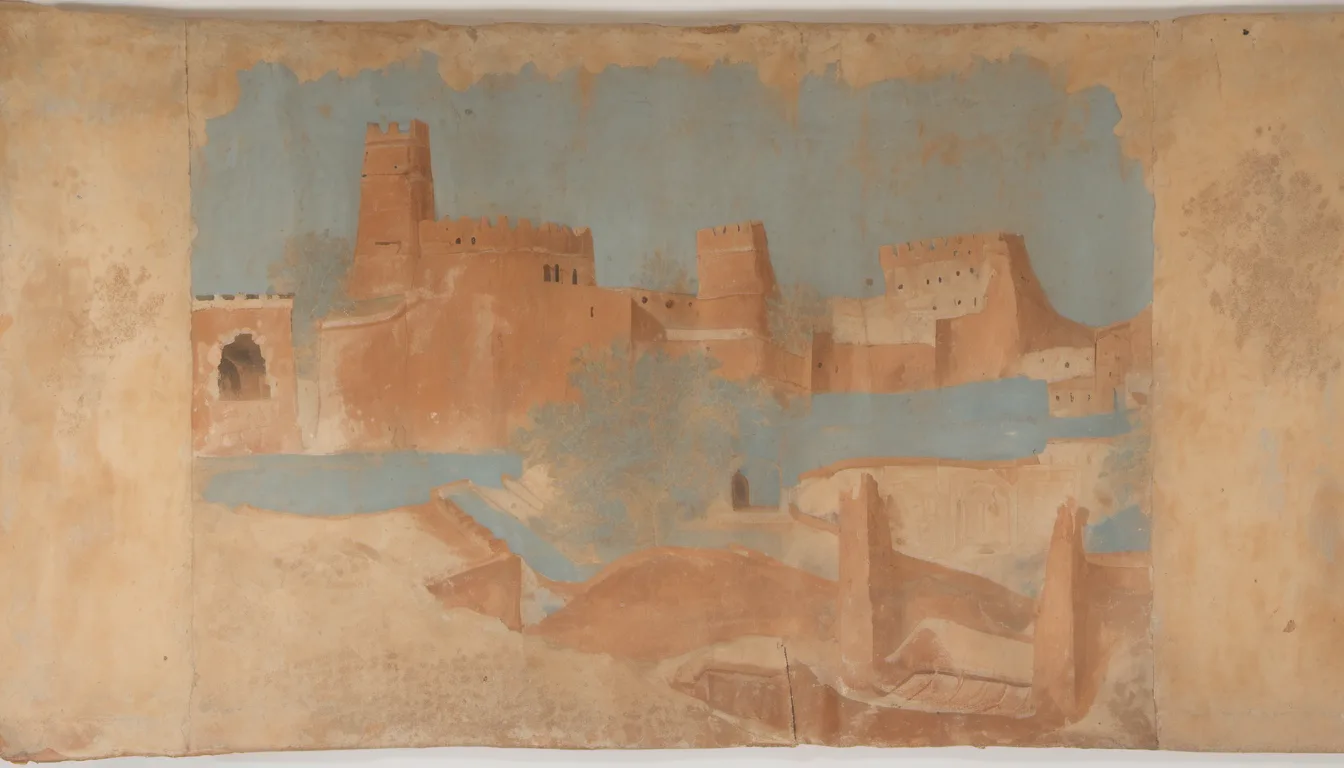
Bahla, Oman
Bahla does not announce itself with the gleam of glass or the bustle of modern commerce. It is a town of earth and memory, situated forty kilometers from Nizwa in the Ad Dakhiliyah Governorate, where the landscape folds into the foothills of Djebel Akhdar. To walk here is to move through a living archive of Omani civilization, where the air feels heavier with the weight of centuries. The settlement is defined by its resilience, a quiet endurance that has persisted since the days when frankincense was more precious than gold and seafaring sultans ruled an empire stretching from East Africa to the Indian subcontinent.
The heart of Bahla is its fort, a massive defensive complex built in the thirteenth century by the Banu Nabhan dynasty. This is not merely a ruin; it is a testament to a time when tribal survival depended on engineering and unity. The fort, along with the town’s extensive twelve-kilometer fortified wall, encloses an oasis that has served as a capital for the Nabāhina at different points in their history. Walking through its stone foundations and adobe towers, you are tracing the boundaries of a power that once dominated the region from the mid-twelfth to the end of the fifteenth century. The structures, many hundreds of years old, speak of a society that valued protection, trade, and intellectual rigor equally.
What makes Bahla singular is not just its age, but its role as a crucible of thought. For centuries, this oasis was renowned as a center for intellectuals, hosting famous imams and scholars who influenced the political and religious landscape of Oman. From the Kharijite communities who resisted normalization by Caliph Harun Al-Rashid to the scholars of later centuries, Bahla was a place where radical concepts of democracy and puritanical faith were practiced. It was here that the Banu Nebhan imposed their rule, not just through force, but through the establishment of Qur’anic schools and mosques that attracted students from the Arab Maghreb. The town’s prosperity was built on this intellectual foundation as much as on its pottery, which dates back to 2500 BC.
Today, Bahla rewards the walker with a slow, deliberate immersion in Omani heritage. The old souq, situated across from the main road, offers pottery, silver artifacts, and handcrafted goods, continuing a tradition where men still trample wadi clay to make it pliable. Nearby, the Castle of Jabrin stands as a three-story masterpiece of the Al Ya'ruba dynasty, its interiors adorned with intricate carvings and ceiling paintings that reflect a time when the castle served as a center for studying medicine, astrology, and Islam. To visit Bahla is to understand that Oman’s history is not just written in stone, but woven into the mud, the clay, and the enduring silence of the mountains.
Bahla is a town that refuses to be hurried. Located in the Ad Dakhiliyah Governorate, forty kilometers from Nizwa and roughly two hundred from Muscat, it occupies a strategic niche at the foot of Djebel Akhdar. Here, the geography dictates the history, and the history dictates the architecture. The settlement is enclosed by the remnants of a twelve-kilometer fortified wall, a defensive perimeter that once protected the oasis from external threats and internal strife. Most buildings within these walls are constructed of traditional mud brick, many of them hundreds of years old, creating a visual harmony that is both stark and deeply inviting. This is not a place of flashy monuments, but of enduring substance, where the earth itself seems to hold the community together.
The origins of Bahla’s significance stretch back to 3000 BC, though its historical prominence crystallized during the medieval Islamic period. The town served as the second capital of the Nabāhina dynasty after Nizwa, and later, during their second period from 1556 to 1624 AD, it became the main capital. This dual role as a political and religious center is etched into the landscape. The Banu Nebhan, the dominant tribe from the mid-twelfth to the end of the fifteenth century, imposed their rule on other tribes and used Bahla as a hub for trade and intellectual exchange. The prosperity of the oasis was not accidental; it was engineered through the construction of formidable fortifications and the establishment of a scholarly tradition that attracted the brightest minds of the era.
At the center of this historical narrative stands Bahla Fort, a thirteenth-century masterpiece of defensive engineering. Built on a stone base with adobe walls and towers, the fort likely includes structural elements from the pre-Islamic period, but its major construction dates to the prosperous time of the Banu Nabhan. The latest reconstruction occurred in the early sixteenth century, ensuring its survival into the modern era. The fort is one of the largest in Oman and is now a UNESCO World Heritage Site. Locals speak of its authenticity, noting that it thrives more than ever as a major attraction. However, the fort also carries a reputation among locals for hosting paranormal activities at night, a whisper that adds a layer of mystery to its already imposing presence. Some believe Bahla is the birthplace of Black Magic, a legend that clings to the stone and adobe like the desert dust.
Beyond the fort, the town’s intellectual legacy is preserved in the Friday Mosque, located to the south-west. Its beautiful sculpted mihrab, or prayer niche, likely dates back to the fourteenth century, serving as a focal point for the community’s spiritual life. Bahla was renowned as a center for intellectuals, producing famous imams and scholars who shaped Oman’s political and religious scene. Figures such as Abu ‘Ubaidah Abdullah bin al-Qāsim in the eighth century, al-Ṣalt bin Khamis al-Kharūṣi in the ninth, and Sheikh Mohammed ibn Barakah in the tenth century all contributed to this reputation. Historical accounts indicate that ibn Barakah’s school attracted students from the Arab Maghreb, highlighting Bahla’s role as a crossroads of ideas.
The town’s commitment to learning continued through the centuries. In the fifteenth century, Mohammed bin Sulaiman bin Ahmed bin Mfarraj and, later, Aisha bint Rashid bin Khaṣīb al-Riyami in the eighteenth century, were among Bahla’s famous intellects. These scholars influenced the political and intellectual scene, ensuring that Bahla remained a center of resistance and innovation. The Kharijite communities, who resisted all attempts at normalization by Caliph Harun Al-Rashid, put into practice their religious concepts, which were at once radically puritanical and democratic. This spirit of intellectual independence is embedded in the town’s identity, making it more than just a collection of old buildings.
Just five kilometers to the southwest of Bahla lies the Castle of Jabrin, a massive three-story structure built during the Al Ya'ruba dynasty in the mid-seventeenth century. This castle was the residence of Imam Sultan bin Saif Al Ya'arubi during the late fifteenth century, though it was expanded and refined in the following centuries. It served as a center for studying medicine, astrology, and Islam, reflecting the interdisciplinary nature of Omani scholarship at the time. The interiors are decorated with intricate carvings and paintings on the ceilings, featuring ornamental flowers that add a touch of elegance to the robust architecture. The tomb of Imam Sultan bin Saif Al Ya'arubi is also enclosed within the fort, making it a site of both historical and spiritual significance.
The economic life of Bahla has always been tied to its resources. The town is famous for its pottery, a craft that dates back to as early as 2500 BC. The clay used comes from the wadi, or river bed, and is processed by men who trample it to make it pliable. This traditional method of working clay is still practiced today, preserving a link to the past. The old souq, located right across the main road leading to the fort, offers pottery, silver artifacts, and other traditional handcrafted items. Visiting the souq is an opportunity to see the tangible results of this ancient craft, where each piece tells a story of the land and its people.
Climate plays a crucial role in the experience of Bahla. With a hot desert climate (BWh) according to the Köppen classification, the town can be challenging to visit during the peak of summer. However, the cooler months offer a more comfortable way to explore the oasis. The single road that cuts into the settlement leads directly to the fort entrance, making it easy to navigate on foot. Walking around the whole oasis allows visitors to appreciate the scale of the fortified wall and the density of the traditional mud-brick buildings. This walkable nature is a gift, allowing for a slow, immersive experience that is increasingly rare in the modern world.
Bahla’s history is also marked by its role in the broader context of Omani trade. In ancient times, the country was the hub of the rich trade in frankincense, an aromatic gum once considered more precious than gold. Known for their seafaring tradition, the Sultans of Oman ruled over a wealthy trading empire that stretched from the coast of East Africa to the tip of the Indian subcontinent from the sixteenth to the nineteenth centuries. Bahla, with its fortresses and strategic location, played an important role in this expansive network. It was a place where goods, ideas, and people converged, shaping the cultural and economic landscape of the region.
Today, Bahla stands as a testament to the resilience of Omani civilization. The ruins of what was a glorious past now remain in this magnificent mountain site, but they are not silent. They speak of a time when the Banu Nebhan imposed their rule, when scholars gathered to debate theology and science, and when the community worked together to build a fortress that has withstood the test of time. To walk through Bahla is to walk through the layers of Omani history, from the pre-Islamic era to the present day. It is a place that rewards those who take the time to listen to the stories embedded in its mud and stone.