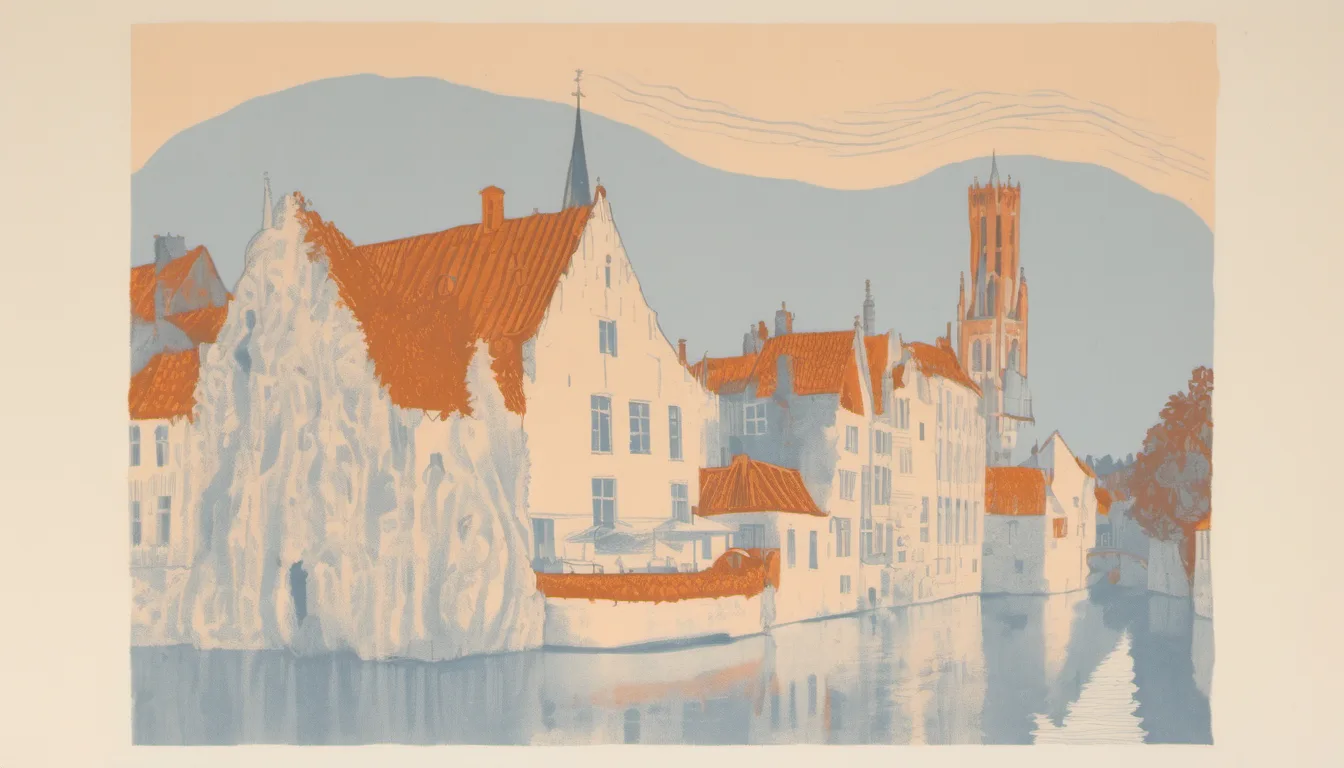
Bruges, Belgium
Bruges does not shout; it whispers across water. Located in the northwest of Belgium, this city of 117,073 souls sits within a 14,099-hectare expanse that includes the coastal strip of Zeebrugge. Yet the heart of the matter lies in its historic center, an oval of 430 hectares recognized by UNESCO. It is a place where the landscape itself has been engineered for connection, a fact that defines its character more than any single monument.
To walk Bruges is to trace the logic of medieval capitalism. The city’s prosperity was not accidental but architectural, built on the Golden Inlet, or Het Zwin. This tidal channel allowed Bruges to become the commercial outpost for the wider region, filling the void left by the decline of other harbors. The silting of this inlet eventually ended the Golden Age, but it left behind a city frozen in time, where the mechanics of trade are visible in the very stones of the Begijnhof and the Bourse.
The reward of walking here is the realization that this was once the financial capital of the world. In 1309, the Bourse opened, likely the first stock exchange, handling sophisticated money markets before Venice even arrived. Foreign merchants from Genoa, Castile, and the Basque Country established consulates here, bringing spices, wool, and capital. The city’s wealth funded a cultural renaissance that produced the Flemish school of painting and the first English printed book.
Today, the city retains the gravity of that history. It is the seat of the College of Europe, a university institute for European studies, bridging its past as a Hanseatic League hub with its modern role in continental governance. The streets are not merely scenic; they are the remnants of a system that invented modern finance. Walking them allows you to see how commerce, art, and politics intertwined to create a singular urban organism that still breathes, albeit quietly, in the Flemish Region.
Bruges, or Brugge, occupies a specific geographic and historical coordinate that has shaped its identity for over a millennium. Located in the northwest of Belgium, it serves as the capital of West Flanders, a province spanning 3,196.99 square kilometers along the North Sea. The city itself covers more than 14,099 hectares, including 1,075 hectares of coastal territory at Zeebrugge, meaning 'Bruges by the Sea.' Yet, the true essence of the city is contained within its historic center, an oval shape of approximately 430 hectares, designated as a UNESCO World Heritage Site. This dense core is where the narrative of European urban development converges, offering a walking experience that is less about sightseeing and more about reading the physical evidence of a once-dominant global power.
The origins of Bruges are rooted in necessity and defense. Prehistoric coastal settlements existed here, but the first significant fortifications were constructed after Julius Caesar’s conquest of the Menapii in the first century BC, designed to protect against pirates. By the fourth century, the Franks had taken over from the Gallo-Romans, administering the region as the Pagus Flandrensis. The ninth century brought Viking incursions, which prompted Count Baldwin I of Flanders to reinforce these Roman defenses. While these raids led to the decline of other trading hubs like Dorestad and Quentovic, Bruges managed to fill the resulting gap, establishing itself as a critical node in early medieval trade networks.
A pivotal moment in the city’s etymology and function occurred with the name’s likely derivation from the Scandinavian 'Bryggja,' meaning 'Quay' or 'Jetty,' rather than just 'bridge.' This linguistic clue points to its maritime destiny. The city’s Golden Age, spanning the 12th to 15th centuries, was fueled by Het Zwin, the Golden Inlet. This tidal inlet provided crucial access to the sea. Although gradual silting threatened direct access from around 1050, a storm in 1134 created a natural channel at the Zwin, re-establishing connectivity. This event allowed Damme to become Bruges’ commercial outpost, extending the city’s reach and securing its status as a strategic crossroads for the northern Hanseatic League and southern trade routes.
By the 13th century, Bruges had developed an autonomous administration and became a central hub for the Flemish and French cloth fairs. The city’s entrepreneurs innovated beyond traditional fair systems, borrowing from Italian models to create new forms of merchant capitalism. Merchants began sharing risks and profits, pooling market knowledge, and employing financial instruments like bills of exchange and letters of credit. The city eagerly welcomed foreign traders, notably Portuguese merchants selling pepper and spices, and Genoese fleets that arrived in 1277, establishing a colony that made Bruges the primary link to Mediterranean trade. This influx brought not only goods but advanced commercial techniques and a flood of capital.
The establishment of the Bourse in 1309 marked a turning point in financial history, likely making it the world’s first stock exchange. It developed into the most sophisticated money market in the Low Countries during the 14th century. Foreign merchants, including Castilian wool traders and Basque merchants from Bilbao, established their own commercial consulates, maintaining separate communities governed by their own laws. This diversity and wealth fueled social upheavals, which were largely contained by a strong militia. The Bruges Matins of 1302, a night-time massacre of the French garrison, led to the Battle of the Golden Spurs in 1302, a victory that cemented local pride. Statues of leaders Jan Breydel and Pieter de Coninck still stand on the Big Market square, commemorating this defiance.
The 15th century saw Bruges reach its cultural zenith under Philip the Good, Duke of Burgundy. His court, established in Bruges alongside Brussels and Lille, attracted artists, bankers, and intellectuals from across Europe. This patronage fostered the Flemish school of oil painting, which gained world renown. The city also became a center of printing; William Caxton published the first book in English here. Political exiles, including Edward IV and Richard III of England, resided in Bruges, further embedding it in the broader narrative of European royalty and power struggles.
However, the city’s fortunes began to wane around 1500 as the Zwin channel silted up, ending the Golden Age. The 16th century saw Bruges become a center of humanism and Protestantism, with international ramifications. In 1578, the city briefly came under Protestant rule, an event marked by the execution of three Franciscan friars on the Burg, which caused significant public unrest. The secession of the Spanish Netherlands in 1584 led to Bruges’ final decline, as it fell behind Antwerp as the economic flagship of the Low Countries. Despite this, the 17th century saw a resurgence in the lace industry, preserving some economic activity.
Walking through Bruges today allows you to see the layers of this complex history. The city’s total population is 117,073, with a metropolitan area of 255,844 inhabitants. The predominant language is Dutch, specifically West Flemish, though French is also spoken. The city’s layout, with its canals and medieval streets, reflects its past as a commercial hub. The presence of the College of Europe, a university institute for European studies, highlights its continued relevance in political and academic circles. The city’s economic importance, derived from its port and historical legacy, remains a key aspect of its identity.
The visual landscape of Bruges is defined by its medieval architecture and waterways. The historic center’s oval shape, covering 430 hectares, is a testament to the city’s planned expansion during its Golden Age. The canals, once vital for trade, now serve as a serene backdrop for urban life. The buildings, many dating from the 12th to 15th centuries, showcase the architectural styles of the period, including Gothic and Renaissance elements. The city’s preservation efforts have ensured that these structures remain intact, offering a unique glimpse into the past.
For the walker, Bruges offers a narrative of rise, peak, and decline, all contained within a walkable distance. The city’s history is not just recorded in books but embedded in its streets, squares, and canals. The legacy of the Hanseatic League, the innovations of merchant capitalism, and the artistic achievements of the Flemish school are all present. The city’s ability to maintain its cultural and political significance, despite economic shifts, speaks to its resilience. Walking Bruges is an exercise in understanding how geography, commerce, and culture intersect to shape a city’s destiny.