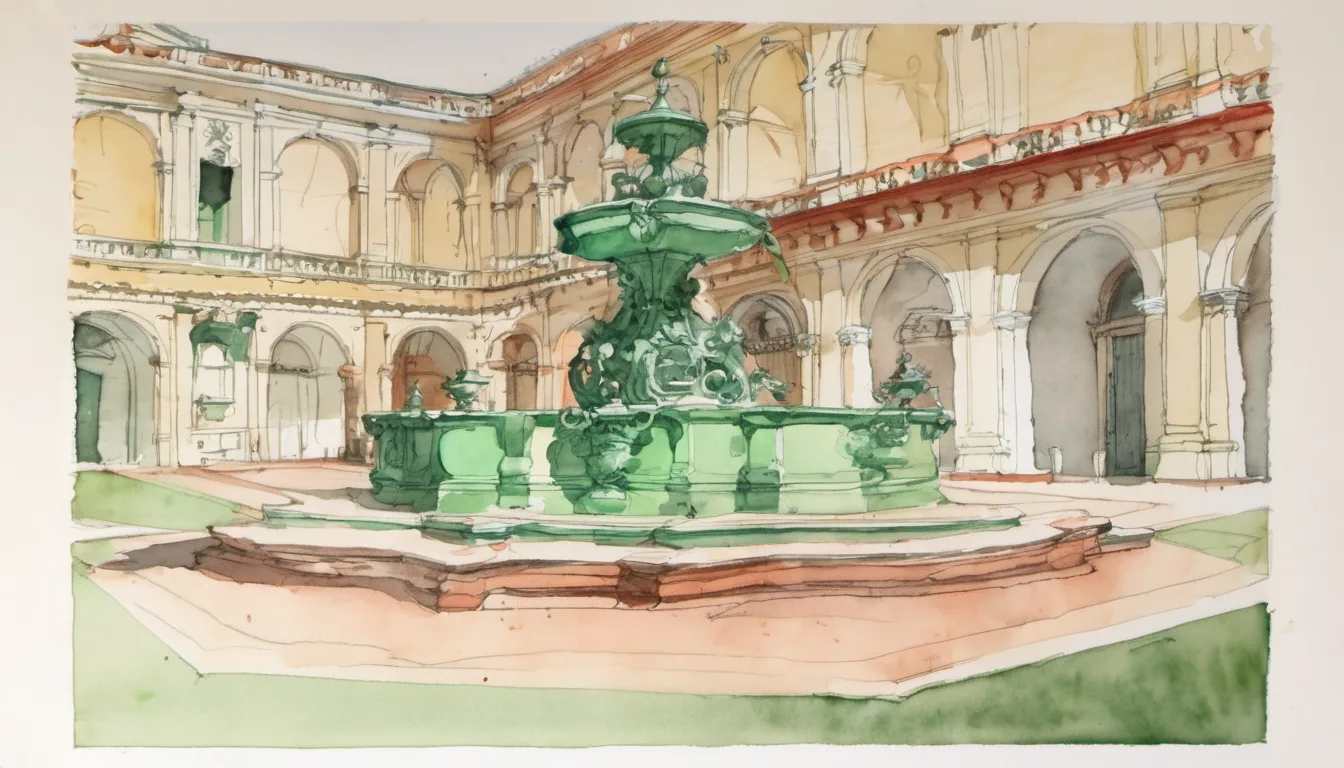
Loreto, Italy
Loreto does not announce itself with fanfare. It rises quietly on Monte Prodo, 127 meters above the Musone river, a modest elevation that nonetheless commands a sweeping view from the Adriatic to the Umbro-Marchigiano Apennines. This is not a city of grand entrances or theatrical plazas. It is a place defined by gravity—both geological and spiritual. The town clings to the hillside, surrounded by olive groves, its identity inextricably linked to the presence of the Basilica della Santa Casa. To walk here is to walk through layers of devotion, where every stone seems to hold a memory of the thousands who have arrived before you, seeking something beyond the mundane.
The heart of Loreto is the piazza, a geometric stage for centuries of architectural ambition. Here, you find a dialogue between power and piety. The Palazzo Comunale, originally the Palazzo Apostolico, was designed by Bramante, its lines crisp and rational. Opposite it stands the college of the Jesuits, and surrounding the space is the Shrine itself, a structure that defies simple classification. Encircling the town is a massive line of walls, engineered by Antonio da Sangallo the Younger, erected in 1518 and reinforced later. These are not merely decorative; they are a testament to the need for protection in a region where faith and violence have often walked hand in hand. Walking the perimeter, you feel the weight of history pressing in from all sides.
What makes Loreto matter is not its size, but its singularity. It is one of the most ancient and important Marian pilgrimage sites in the Catholic world. The legend of the Santa House—said to be the actual home of the Virgin Mary in Nazareth, transported by angels in 1291—anchors the town’s existence. Whether you view this as miracle or myth, the result is the same: a place where the sacred is tangible. The walls, the basilica, the narrow streets leading up to the summit, all serve this central mystery. You are not just visiting a city; you are entering a narrative that has shaped the spiritual geography of Europe for seven centuries.
Walking Loreto rewards those who look beyond the obvious. The art gallery within the Palazzo houses works by Lorenzo Lotto and Annibale Carracci, but the true masterpiece is the interplay of light and shadow on the ancient stone. In December, the town ignites with the focaracci, massive bonfires lit to guide the Holy House’s mythical journey. These fires, started by the Capuchin friar Tommaso in 1617, turn the hillside into a beacon. To walk here is to understand that place is not just location; it is meaning. Loreto offers a rare clarity, a quietude found only where history is so deeply embedded in the landscape that you cannot help but feel its pulse.
Loreto, in the province of Ancona, sits at 127 meters above sea level on the right bank of the Musone river. It is 22 kilometers by rail south-southeast of Ancona, a distance that feels significant only when you consider the weight of what lies ahead. This hill town is not defined by its population of 13,081, nor by its position on a map. It is defined by the Basilica della Santa Casa, a structure that has drawn pilgrims from across the globe for over seven centuries. To walk Loreto is to traverse a landscape where the earthly and the divine are indistinguishable. The town rises on Monte Prodo, a modest height surrounded by olive groves, yet it dominates the horizon with the silhouette of its dome and bell tower, crowned by the figure of the Madonna. The view from here is expansive, stretching from the Adriatic Sea to Monte Conero and the distant Apennines, but the gaze of the visitor is inevitably drawn upward, toward the shrine.
The city developed organically around the basilica, growing from the intersection of passing routes. The tradition holds that this is the house where the Virgin Mary was born, raised, and received the Annunciation from the Archangel Gabriel. After the Resurrection, the Apostles are said to have gathered here to celebrate the Eucharist. This belief, rooted in the earliest centuries of Christianity, transformed a simple dwelling into a site of immense spiritual gravity. The town’s layout, its streets, its very existence, is a response to this singular fact. To walk through Loreto is to walk through a physical manifestation of faith, where every corner seems to whisper the name of the Holy House.
The legend of the Santa House’s arrival in Loreto is complex, layered with history, myth, and perhaps a touch of political maneuvering. According to tradition, in May 1291, Nazareth and all of Palestine fell under the control of the Mamluks of Egypt. Fearing desecration, angels are said to have lifted the house and flown it away. They first landed in Tersatto, near Fiume (now Rijeka, Croatia), where woodcutters discovered the structure. However, Tersatto was prone to banditry. Three years and seven months later, the angels moved the house again, crossing the Adriatic to the Marche region. They first placed it near Ancona, on the hill of Posatora, a name derived from the Latin posa-et-ora (stop and pray). It remained there for nine months.
The house was moved once more, this time to Banderuola, near Porto Recanati. Shepherds reported seeing a blinding light from the clouds, behind which stood the house. Yet, this location was too close to the sea, vulnerable to Turkish raids and the same predation by criminals. Eight months later, the angels lifted the house again, placing it on Monte Prodo, on land owned by Count Stefano and Simone Rinaldi di Antici. The brothers, profiting from the influx of pilgrims, petitioned Pope Boniface VIII for ownership. Finally, in late 1296, the angels moved the house to a public spot on the road from Recanati to its port, a place no one could claim. It was placed on a hill covered with laurel trees—laurus in Latin—giving the place its name: Lauretum, later Loreto.
This journey, known as the Transliteration of the Holy House, is depicted in artworks from centuries past. In the Marche and Umbria, the tradition of lighting large fires, known as focaracci or fogaró della Venuta, persists. These fires are lit on the night between December 9 and 10 to illuminate the path of the Holy House. In 1617, the Capuchin friar Tommaso from Ancona spread this custom throughout the region. Consequently, the feast of the Madonna of Loreto is celebrated on December 10, which is also the Day of the Marche region. This date is not arbitrary; it is the anniversary of the house’s final arrival, a moment that anchors the town’s identity in time.
The architectural ensemble surrounding the piazza is a testament to the town’s importance. The four sides of the square are occupied by significant monuments. The college of the Jesuits stands as a center of learning and faith. The Palazzo Comunale, formerly the Palazzo Apostolico, was designed by the renowned architect Bramante. It houses an art gallery featuring works by Lorenzo Lotto, Vouet, and Annibale Carracci, as well as a collection of maiolica. The Shrine of the Holy House itself is a masterpiece of religious architecture, its design evolving over centuries to accommodate the growing number of pilgrims. Encircling the town is a massive line of walls, designed by the architect and military engineer Antonio da Sangallo the Younger. Erected in 1518 and reinforced in the 17th century, these walls were a necessary defense in a turbulent era.
Scientific analysis of the Santa House has been ongoing for centuries. Early empirical studies, later continuing with Galileian methods, suggest the building’s originality and probable origin in the East, specifically Palestine. The architectural style and construction materials, absent from the Italian territory, particularly the Marche, are typical of the Holy Land at the time. However, geologist Antonio Veggiani argues that all lithological types found in the house’s walls also exist in the Umbro-Marchigiano Apennines. Graffiti on the walls, depicting saints of the Eastern church, attest to the passage of pilgrims since the time of Emperor Constantine. The dimensions of the house match the hole left in Nazareth where the house once stood.
An alternative theory suggests the house was moved by the Angeli Comneno family, a branch of the imperial family of Constantinople. This theory remains debated. All bricks in the house are still bonded with mortar used in Palestine: a mixture of hydrated calcium sulfate (gypsum) mixed with charcoal powder, a technique known in Palestine two thousand years ago but never used in Italy. This implies the house was moved as a single block. Professor Emanuele Mor, an electrochemistry professor at the University of Genoa, supports the supernatural translation theory. Two coins found in the subsoil of the house, linked to Guido II de la Roche, duke of the French fiefdom of Athens from 1287 to 1308, provide a tangible link to the Angeli family. These coins, buried in the foundations of important sacred buildings to indicate the era and protagonists, support the historical hypothesis.
The uncertainty surrounding the Angeli theory is legitimized by documents dated after 1294, whose authenticity is doubtful. In May 1900, future Bishop of Digione Mons. Landrieux was informed by Giuseppe Lapponi, a pontifical archiatrist, of documents in the Vatican archives. These documents claimed a noble Byzantine family, Angeli or De Angelis, descendants of the Constantinople emperors, removed the walls of the Madonna’s house from Nazareth in the 13th century to save them from Muslim devastation. These documents were never found, despite numerous searches. A copy of a presumed ancient diplomatic code, the Chartularium Culisanense, is conserved at the Public State Library of the Montevergine Abbey, offering a fragment of this complex narrative.
Today, Loreto is twinned with Mariazell, Austria; Fátima, Portugal; Altötting, Germany; Częstochowa, Poland; Lourdes, France; Nazareth, Israel; Harissa, Lebanon; and Għajnsielem, Malta. These connections highlight Loreto’s status as a global Marian center. The Territorial Prelature of Loreto and the Sisters of Loreto continue the work of care and devotion. The shrine remains active, drawing millions of visitors annually. To walk Loreto is to walk through a living history, where the past is not dead but present in every stone, every prayer, and every view. The town’s significance lies not in its size, but in its ability to hold space for the sacred, a rare quality in the modern world.
The experience of Loreto is one of quiet intensity. The hilltop location offers panoramic views, but the true reward is internal. The interplay of light on the ancient walls, the sound of pilgrims’ footsteps, the scent of olive groves, and the sight of the dome against the sky create a sensory tapestry. The art within the Palazzo Comunale, the engineering of the walls, and the legend of the Santa House combine to create a place of singular power. Loreto is not just a destination; it is a state of mind. It invites you to slow down, to look closely, and to listen to the whispers of history. In a world of noise, Loreto offers a profound silence, broken only by the wind from the Adriatic and the distant toll of the bell tower.
Do not miss around Loreto
2 placesEvery place below is a ten-to-fifteen minute walk from the last.