Torre Guinigi
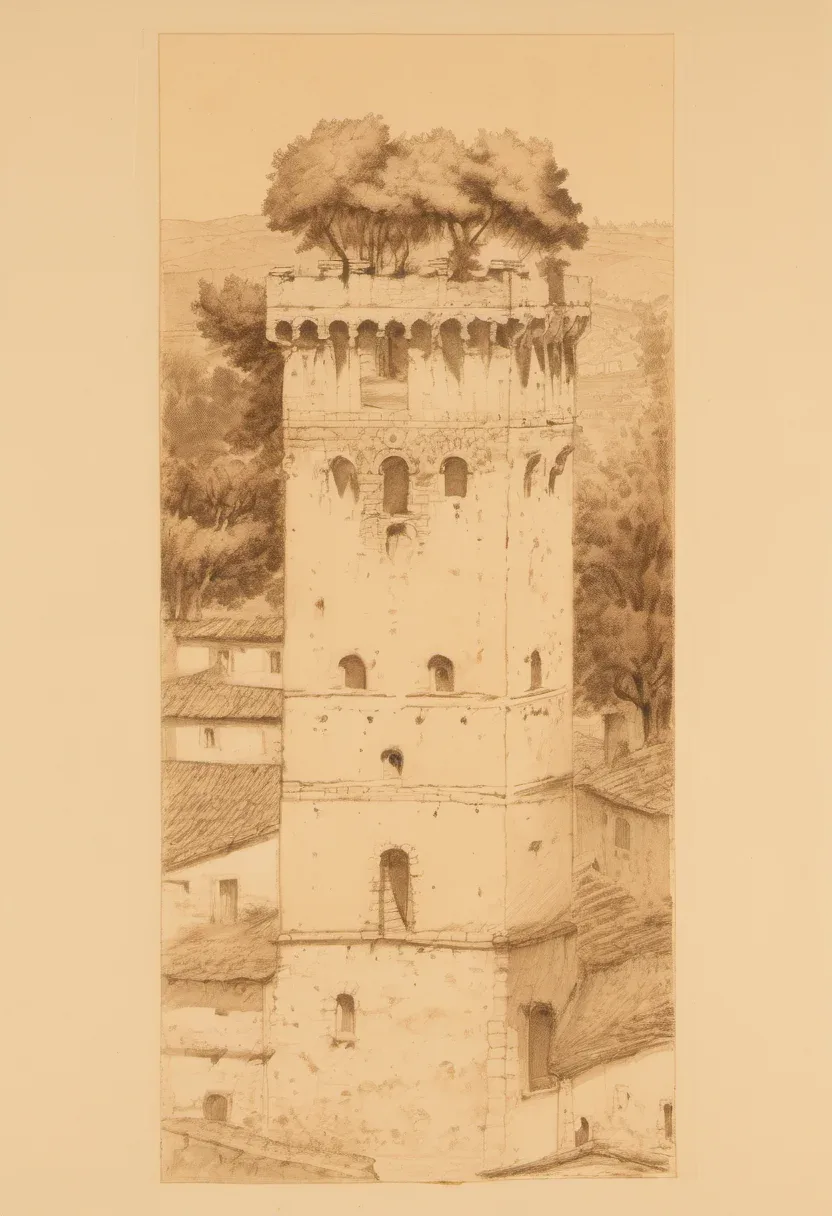
Torre Guinigi does not look like it should work. A brick tower, forty-four metres up a medieval Tuscan street, crowned not with a bell or a flag but with a stand of holm oaks — a garden, growing in mid-air, on top of a fourteenth-century tax haven for the rich. Lucca once bristled with structures like this. Only a handful survive. This is the one everyone remembers.
The Guinigi were merchants and bankers, and by the second half of the fourteenth century they were, in effect, running the city. Wealthy Lucchese families had been building status towers within the walls since the early 1300s, when the city counted more than 250 of them alongside its bell towers, packed inside a circuit far tighter than today's. The Guinigi wanted something softer than the usual grim stone block. So they topped theirs with trees — a common enough gesture among the grander Lucca palazzi, but rarely pulled off with this much conviction. The tower became, in effect, a green flourish planted on top of the family's own monument to power.
Most of Lucca's private towers didn't survive the sixteenth century — they were cut down or pulled apart. Torre Guinigi is the one exception among them, left whole while its neighbours were shortened into stumps or vanished outright. In 1968, following the wishes of the family's last descendant, the tower and the adjoining palazzo on via Sant'Andrea passed to the city. It has been open to the public ever since.
Getting to the top means 230 steps, climbed over roughly two dozen short flights. The first stretch is manageable enough; the last is not, narrowing into slim metal staircases that force single file. Along the way, the interior walls carry paintings of medieval life, hung as if the tower itself were still keeping a private gallery. At the summit, the reward is the garden itself — a walled box of earth holding seven holm oaks, their exact planting date lost. A fifteenth-century chronicle by Giovanni Sercambi shows a Lucca tower already crowned with trees, hinting the custom is old, even if today's oaks were almost certainly replanted since.
From up there, Lucca opens out beneath its own rooftops: the oval scoop of Piazza dell'Anfiteatro, the tight weave of the historic centre, and beyond the walls, a ring of mountains — the Apuan Alps to the northwest, the Apennines to the northeast, Monte Pisano to the south. Climb for the oddity of the trees. Stay for the view that explains why the Guinigi bothered building this high at all.
Torre Guinigi does not look like it should work. A tower of stone and brick rises forty-four metres above a street in central Lucca, and at the top, instead of a bell chamber or a flagpole, there is a stand of holm oaks — a small wood, rooted in a box of earth, growing in mid-air on top of a fourteenth-century status symbol. Lucca once had hundreds of towers like this crowding its skyline. Almost none of them remain. This is the one that survived intact, and it survived, in part, precisely because of its trees.
The tower stands at the corner of via Sant'Andrea and via delle Chiavi d'Oro, with its entrance at via Sant'Andrea 45, built in the local Romanesque-Gothic style shared by the city's other surviving medieval towers. It belongs to the Guinigi, a family of merchants and bankers who had, by the second half of the fourteenth century, become the effective rulers of the city. Tower-building was already a Lucchese habit by then. At the start of the 1300s the city counted more than 250 towers and countless bell towers, all packed within a circuit of walls considerably tighter than the one standing today — a forest of stone raised by rival families competing to outbuild one another in height and visibility, each tower doubling as a very public boast.
What set the Guinigi tower apart was the softening gesture on top. Rather than leave their tower as another severe stone block, they crowned it with trees, a flourish shared by a few other grand Lucchese palazzi of the era but rarely carried off with such conviction. It read as a kind of rebirth planted directly above what was, underneath the greenery, a monument to the family's own dominance over the city — power dressed up as a garden, softening a fortress into something closer to a folly.
That combination of ambition and softness may be exactly what saved it. Most of Lucca's private medieval towers did not make it past the sixteenth century; they were cut down to stumps or demolished outright as the city's skyline was reshaped and the old competition among noble families lost its point. Torre Guinigi is the sole exception among them — the only privately owned medieval tower left whole, neither truncated nor torn down, still standing at full height while the forest of rivals around it thinned out to almost nothing.
The family kept possession of it for centuries afterward. In 1968, by the will of the Guinigi line's last descendant, the tower and its adjoining palazzo on via Sant'Andrea passed into the hands of the city of Lucca. What had spent six hundred years as a private declaration of wealth became, with that one bequest, a public landmark — open to visitors ever since, with none of the fuss such a handover might have involved.
Reaching the top requires committing to 230 steps, spread across close to two dozen flights. The lower stretches are manageable, stone stairs wide enough to ease you upward without much drama. The final approach is another matter entirely: the stairs narrow into slim metal flights, steep and tight enough that climbers move in single file, hands on both rails. It is not a hard climb by the standards of Tuscany's hill towns, but it earns its reward slowly, flight by flight, with no shortcuts once you've committed.
Along the way, the tower's interior walls carry a scattering of paintings depicting scenes of medieval life — a quiet gallery tucked inside the stairwell, easy to miss if you're watching your footing on the metal steps instead. They are a reminder that this was first a lived-in structure attached to a family palazzo, not a folly raised purely to be climbed centuries later by tourists with cameras. The tower was domestic before it was a landmark.
At the summit sits the garden that gives the tower its identity: a walled masonry box filled with earth, holding seven holm oaks. Nobody knows precisely when it was planted. The best clue comes from a fifteenth-century chronicle by Giovanni Sercambi, whose illustrations of Lucca show one of the city's towers already crowned with trees — evidence the custom is old, even if the oaks growing there today were almost certainly replanted at some later point, the current trees standing in for whichever generation came before them. The garden, in other words, is older than anyone can prove and younger than it looks.
The view is the other half of the reward, and arguably the better half. From the top, Lucca spreads out below in its own compact geometry: the oval curve of Piazza dell'Anfiteatro traced into the street plan, the dense weave of the historic centre, and rooftops running out toward the city walls. Beyond them, the horizon turns mountainous on every side — the Apuan Alps to the northwest, the Apennines to the northeast, Monte Pisano to the south, a full ring of high ground framing a city that, for a few centuries, tried its best to out-tower itself.
Climb it for the strangeness of trees rooted in brick at forty-four metres. Stay at the top for the view that makes plain why a family of bankers thought this particular pile of stone was worth building in the first place — and why, unlike almost every other tower that once stood in Lucca, this is the one nobody ever cut down.