Mausoleum of Theodoric
Ravenna's skyline is famous for its mosaics: gold on blue, all soft Byzantine light. Then, just outside the old city walls, comes a building that answers to none of that. The Mausoleum of Theodoric is capped by a single stone, carved as one solid piece, ten metres across and weighing around 230 tonnes. It was brought in by sea and hoisted onto the finished structure using twelve loop-handles carved into its rim. How the builders actually got it up there afterward is still not fully understood.
Theodoric the Great built the mausoleum in AD 520 as his own future tomb, though it isn't entirely certain he oversaw the work himself; some accounts credit his daughter Amalasunta with completing it after his death. Either way, the choice of material was a statement. Almost everything else in Ravenna is brick. This is stone, hauled from a quarry some 400 kilometres away by land, in a conscious echo of Diocletian's palace at Split. The builders used opus quadratum, a Roman stone-cutting technique that had gone out of use four centuries earlier: a Gothic king borrowing a defunct Roman method to raise something that owed nothing to Roman taste.
The structure rises in two stacked decagons. The lower one, ringed with niches under round arches on the outside, opens inward to a cross-shaped chamber, probably used for funeral rites. An external stair climbs to the upper floor, decagonal outside but circular within, once wrapped in a colonnaded walkway of which only the springs of arches survive in the stonework. At its centre sits a fragmentary red porphyry tub, likely salvaged from a Roman bath complex, in which Theodoric was laid to rest.
That rest didn't last. Once Byzantine rule reached Ravenna, his remains were removed, and the mausoleum became a Christian oratory, known to a ninth-century chronicler as "Santa Maria ad Farum," for a nearby lighthouse and port. After the mid-sixth-century Pragmatic Sanction, the building passed into the hands of the Church of Ravenna. Centuries later, silt from a nearby stream crept in and partly buried it; the site wasn't drained and excavated until the late nineteenth century.
Look closely at the roof stone and you'll find a crack running through it, the kind of flaw that tends to breed folklore, and around Theodoric's tomb, it duly has. Today the mausoleum is UNESCO-listed, grouped with seven other early Christian monuments of Ravenna, valued precisely because it isn't like them: Gothic in style and ornament, indebted to nobody's Rome or Byzantium, and the only surviving tomb of a king from this period anywhere.
Ravenna's skyline is famous for its mosaics: gold on blue, all soft Byzantine light. Then, just outside the old city walls, comes a building that answers to none of that. The Mausoleum of Theodoric is capped by a single stone, carved as one solid piece, ten metres across, three metres tall, and weighing around 230 tonnes. It was brought in by sea and hoisted onto the finished structure using twelve loop-handles carved into its rim. How it actually got up there afterward is still debated. One theory has it raised gradually as the walls rose beneath it. Another suggests the builders buried the finished structure in an earthen ramp, slid the stone up the slope, then dug the mausoleum back out. A third imagines a temporary dam built around the site, flooded into a pool, with the monolith floated up on a raft. None of the three has been proven, and the mausoleum keeps the answer to itself.
Theodoric the Great, king of the Ostrogoths, had the mausoleum built in AD 520 as his own future tomb. Even that much isn't entirely settled: it isn't clear whether he oversaw the work himself or whether his daughter Amalasunta saw it finished after his death. What is clear is the intent behind the material. Almost everything else in Ravenna, mosaics included, is built of brick. This is stone, hauled from a quarry some 400 kilometres away by land, a conscious echo of Diocletian's palace at Split on the Dalmatian coast. It is not a subtle reference. A Gothic king, ruling from inside the old Roman world, chose to build his tomb out of the one material his adopted city didn't use.
The technique is just as pointed. The blocks are laid in opus quadratum, a Roman stone-construction method that had already fallen out of use for four centuries by the time Theodoric's masons picked it back up. According to UNESCO's own evaluation, the mausoleum's significance rests on exactly this contradiction: a building whose style and decoration are Gothic through and through, owing nothing to Roman or Byzantine art, built using a Roman technique nobody had touched in a century or two either side of four hundred years.
It stands on ground that had been a burial site long before Theodoric arrived: a necropolis just outside the city walls, one that may have kept a section set aside for the Goths themselves. The mausoleum, in other words, wasn't an intrusion so much as a continuation, dressed in unfamiliar stone.
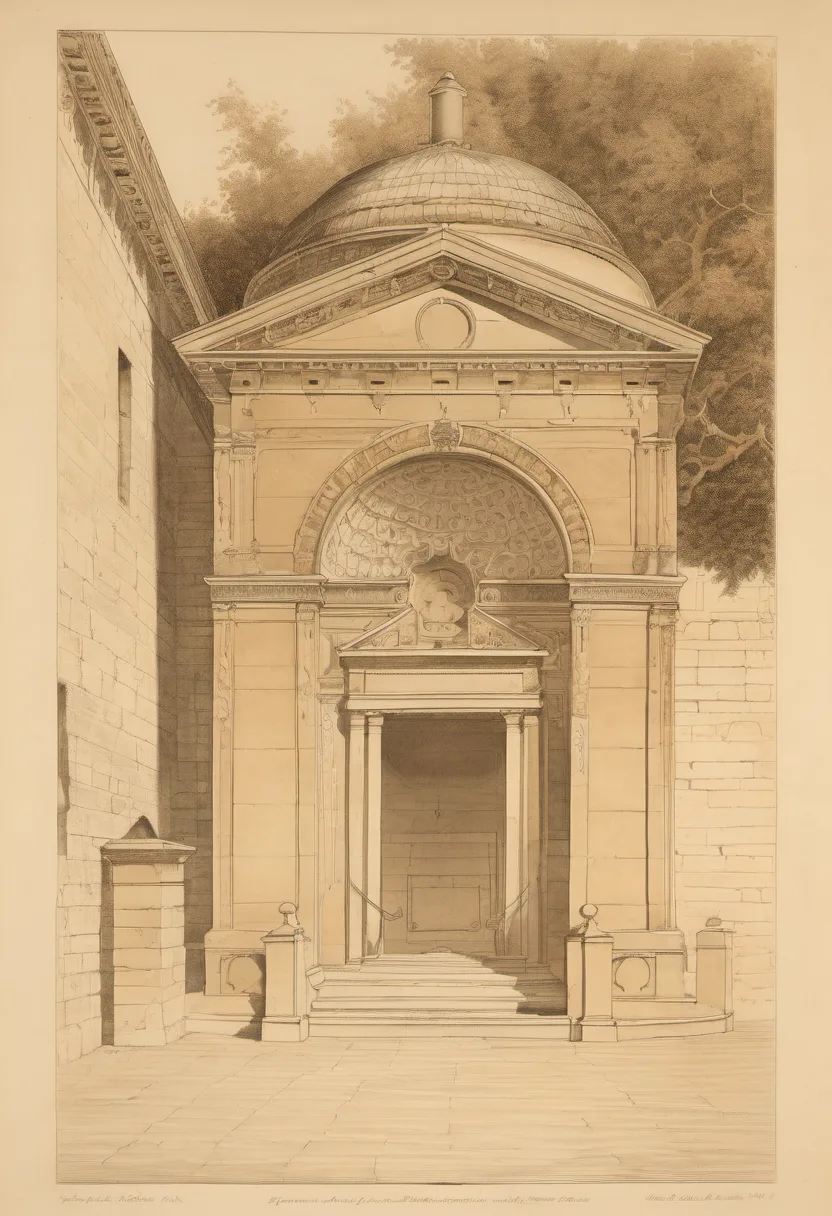
The structure itself rises in two stacked decagons. The lower tier is decagonal on the outside, its ten faces broken by niches under solid round arches. Inside, though, the plan turns cruciform: a cross-shaped chamber that probably served as a chapel for funeral liturgies, the practical heart of the building tucked beneath its more ceremonial upper half.
An external stair leads up to that second level, which is decagonal outside but resolves into a circle at the level of its frieze. It was once encircled by a colonnaded ambulatory, a walkway of slim columns that would have softened the building's blunt mass; almost nothing of it survives now beyond the springs of arches still visible where they once met the wall. The interior is a single circular room, with one arched niche marked by a carved cross. At its centre, still, is a fragmentary red porphyry tub, its lid long gone, almost certainly lifted from a Roman bath complex rather than made for the purpose. This is where Theodoric's body was laid.
It didn't stay there. When Byzantine rule reached Ravenna, his remains were removed, and the mausoleum was reconsecrated as a Christian oratory. Andrea Agnello, a chronicler writing in the first half of the ninth century, records that in his day the building was known as "Santa Maria ad Farum," named for its closeness to a port with a lighthouse. After the Pragmatic Sanction of 560, the mausoleum passed formally into the hands of the Church of Ravenna, whatever ceremony that involved now lost to the record.
The building's decoration carries its own quiet argument. A band running around the exterior is worked in a "pincer," or tongs, motif, drawn from Gothic goldsmithing rather than the Roman-Byzantine repertoire used everywhere else in the city; it is, in fact, the only such piece of Gothic-derived ornament to survive in Ravenna. The heavy cornice above it, meanwhile, shows a Syriac influence, one more thread in a building that mixes Roman construction, Gothic decoration, and eastern Mediterranean detailing without particularly reconciling any of them.
Time did what politics eventually does to monuments: it buried this one. A nearby rivulet silted up over the centuries and partly submerged the mausoleum, and it wasn't until the late nineteenth century that the water was drained and the building properly excavated back into view.
Look up at the roof stone today and you'll notice a crack running across it, the kind of flaw that, on a building this strange, was never going to stay just a flaw. It became, in time, the seed of local legends about Theodoric himself, the specifics of which have shifted with the telling. In 1996 the mausoleum was inscribed on the UNESCO World Heritage list alongside seven other Early Christian monuments and mosaics of Ravenna, but its citation reads differently from theirs: it is valued not for fitting the city's Byzantine character but for standing apart from it, the only surviving tomb of a king from this period anywhere in the world.