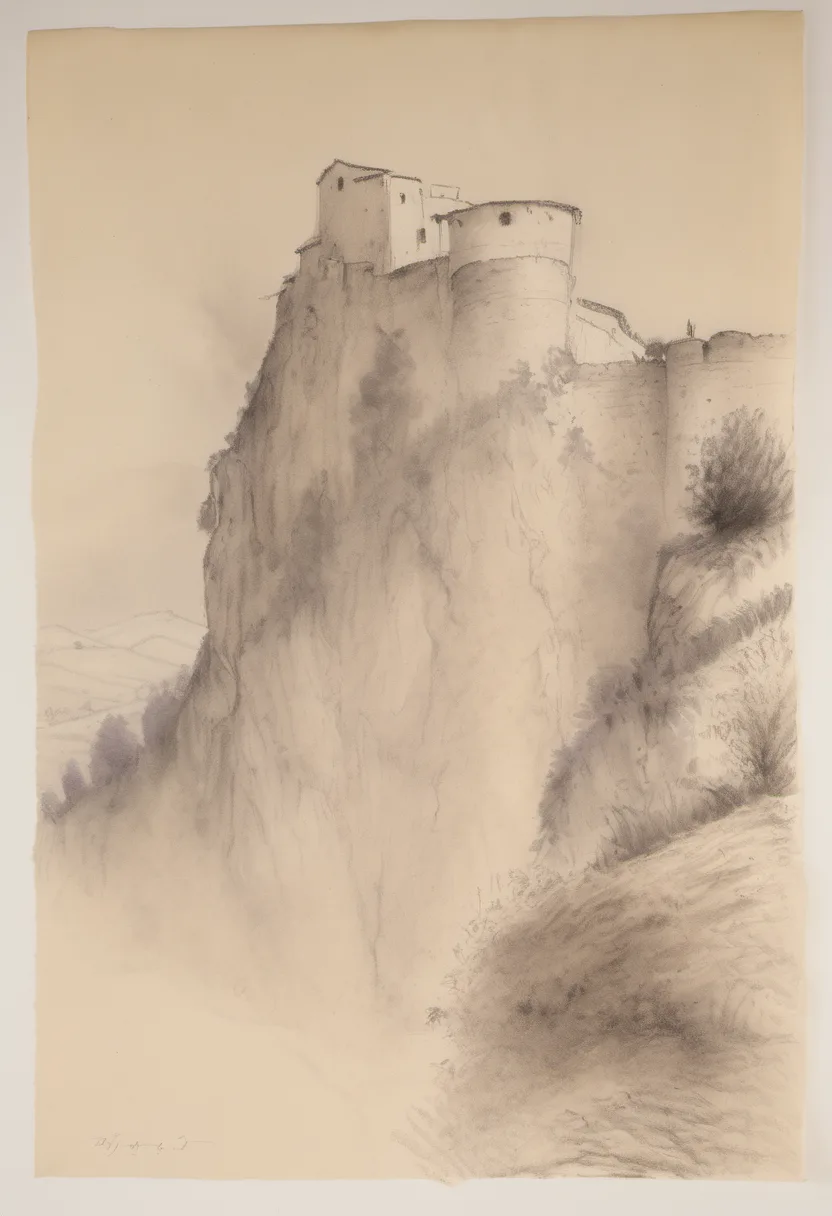
San Leo, Italy
San Leo does not announce itself with fanfare. It rises from the Valmarecchia on a sheer spur of rock, a geological stubbornness that has dictated its history for millennia. To reach it is to accept a vertical challenge, a climb that separates the casual visitor from those who understand why this place matters. It is not merely a village; it is a fortress-town, a strategic node in the Montefeltro region, and a place where the landscape itself feels like a participant in the narrative. The air here is thinner, sharper, carrying the scent of dry stone and distant sea.
The city’s singular feature is its elevation. At 600 metres, it commands a view that stretches to the Adriatic and the independent Republic of San Marino. This is not a scenic overlook; it is a defensive position that has been contested by kings, dukes, and popes. The fortress crowning the peak is not a tourist afterthought but the reason for the city’s existence. It is a place of imprisonment and power, where Cagliostro and Felice Orsini were held, and where the very geology has protected the inhabitants from invasion for centuries. Walking here is an exercise in understanding why location is destiny.
The urban fabric is dense, vertical, and remarkably intact. You will navigate narrow streets that follow the contours of the rock, passing the Romanesque co-cathedral and the Palazzo Mediceo. The latter, built between 1517 and 1523, bears the lily of Florence and the oak leaves of the Della Rovere, marking a complex political history written in stone. This is a place where art and politics intersected, where Piero della Francesca’s portraits of Federico da Montefeltro encode the very map of the territory. The city is a puzzle of history, waiting to be solved by the attentive walker.
What rewards the walker is the silence that accompanies the height. Below, the valley unfolds in layers of agricultural land and scattered hamlets. Above, the sky dominates. The UNESCO-recognized Vita Sanctorum Marini et Leonis, added to the register in 2025, speaks to the deep spiritual roots of this place, tracing back to the Dalmatian hermit Leo. But the reward is not just historical; it is sensory. The light on the limestone, the texture of the ancient walls, and the panoramic clarity offer a perspective that is rare in Italy. San Leo is not a place to rush through; it is a place to stand, look, and understand the weight of stone and time.
San Leo is a geological anomaly that became a political necessity. Perched on a limestone spur in the Valmarecchia, it sits at 600 metres, high enough to see the sea but isolated enough to be defensible. This is the heart of the Montefeltro, a region whose name derives from the Latin Mons Feretri. Some scholars link this to a temple of Jupiter Feretrius, evidenced by columns in the co-cathedral, while others argue it refers to the shape of the hill, resembling an ancient funeral bier. Regardless of the etymology, the form of the rock has dictated the form of the city. It is a castrum, a fortress, a refuge. The name San Leo, acquired in the 9th or 10th century, honors the Dalmatian hermit Leo, companion of Saint Marinus, whose vita was recently inscribed in UNESCO’s Memory of the World Register in 2025. This is not just a town; it is a monument to endurance.
The history of San Leo is a history of siege. In the early Middle Ages, between 961 and 963, Berengario II, the last king of the Lombard Kingdom of Italy, was imprisoned here by Otto I of Saxony. This event set the tone for centuries to come: San Leo was a place where power was consolidated and where dissidents were neutralized. The town passed through the hands of the Counts of Montecopiolo, the Da Montefeltro, the Malatesta, the Medici, and the Della Rovere, before finally coming under the direct control of the Papal States in 1631. Each faction left its mark, not just in blood, but in stone. The architecture is a palimpsest of these conflicts, a physical record of the shifting tides of Italian history.
The fortress is the dominant feature, a massive structure that seems to grow out of the rock itself. It is not merely a building; it is a landscape. The fortress has served as a prison for some of Italy’s most notorious figures, including Felice Orsini, who plotted against Napoleon III, and the charismatic adventurer Cagliostro. These are not just anecdotes; they are testaments to the fortress’s reputation for inescapability. To walk its ramparts is to walk the same paths as those who waited for execution or plotted escape. The fortress also houses the Museo delle Mura, offering a glimpse into the military engineering that kept this town safe for centuries. It is a place where the boundary between the natural rock and the man-made wall is indistinguishable.
Art and politics intersected here with unusual intensity. Federico da Montefeltro, the famous condottiero and Duke of Urbino, made San Leo his first military conquest, a feat previously considered impossible. His portrait by Piero della Francesca, part of the famous diptych with Battista Sforza, contains a hidden map of the Montefeltro. A study begun in 2019, titled 'The Face of the Montefeltro,' revealed that the moles on Federico’s face, when superimposed on a map, align perfectly with key locations: Urbino, San Leo, Pennabilli, and Carpegna. San Leo is one of these points, a geographical anchor in Renaissance art. This is not mere decoration; it is a claim of ownership, a subtle assertion of power painted on a canvas. It shows how deeply the territory was woven into the identity of its rulers.
The religious architecture is equally significant. The San Leo Co-Cathedral, rebuilt around 1173 by Lombard masters, is a prime example of Romanesque style in the region. It stands as a testament to the town’s ecclesiastical importance. Nearby, the Torre Campanaria, or bell tower, rises from the summit of the 'Monte della Guardia,' the second peak of the Masso. Originally part of the episcopal citadel destroyed by the Malatesta in the 14th century, the tower now stands isolated, a silent sentinel. The Convento di Sant’Igne, dating from the 13th century, houses a fragment of the elm tree under which Saint Francis preached in 1213. This tree is depicted in the town’s coat of arms, linking the spiritual and the civic. The convent also contains a 1535 fresco of the Madonna in Throne with Saints, a work of quiet devotion amidst the martial history.
The Palazzo Mediceo, constructed between 1517 and 1523, serves as a bridge between the secular and the sacred. Built for the governor of the Florentine Republic, it bears the lily of Florence and the date 1521. Later, the Della Rovere family expanded it, adding a theater. Today, it houses the Museum of Sacred Art. This building encapsulates the political maneuvering of the Renaissance, where art was a tool of statecraft. The palace is not just a museum; it is a document of the power struggles that defined the region. It reflects the complex relationships between Florence, the Papacy, and the local lords, a web of alliances and enmities that shaped the physical landscape of San Leo.
Transport history adds another layer to the city’s isolation and connection. San Leo was served by the Rimini–Novafeltria railway, with a terminus in Torello from 1921. The government of San Marino had lobbied for this station since 1905, contributing 1,000 lire annually for fifty years. The line operated until 1960, providing the closest rail link to the Republic of San Marino. Another project, the Santarcangelo–Urbino railway, was abandoned in 1933, leaving behind viaducts and a tunnel in Il Peggio, now a mushroom farm. These remnants of industrial ambition highlight the town’s struggle for connectivity, a struggle that ended with the closure of the lines. The town stands alone, accessible only by road, a fact that has preserved its character.
The modern history of San Leo is marked by a significant administrative shift. Until 2009, it was part of the Province of Pesaro and Urbino in the Marche region. Following a referendum in December 2006, San Leo was detached from Marche and joined Emilia-Romagna, specifically the Province of Rimini, on 15 August 2009. This move was contested by the Marche region but upheld by the Constitutional Court. This political realignment reflects the town’s cultural and economic ties to the Adriatic coast rather than the Apennine interior. It is a reminder that boundaries are fluid, and that San Leo’s identity is shaped by its relationships with both the sea and the mountains.
Walking San Leo is an exercise in reading the landscape. The town is one of I Borghi più belli d'Italia, but this title does not do justice to its ruggedness. The streets are steep, the steps are numerous, and the views are expansive. You can see San Marino on a clear day, a small republic that shares a complex history with its larger neighbor. The town’s population, around 2,868, is small, but its historical footprint is large. The presence of foreign residents, particularly from Albania, Morocco, and Romania, adds a contemporary layer to the ancient stone. It is a living town, not a museum piece, though it wears its history on its sleeve.
The cultural significance of San Leo extends beyond its physical boundaries. The Vita Sanctorum Marini et Leonis, containing the biographies of Saint Marinus and Saint Leo, was added to the UNESCO Memory of the World Register in 2025. This recognition highlights the town’s role as a spiritual center. The town has been visited by saints and scholars, including Saint Francis in 1213 and Dante in 1306. These visits underscore the town’s importance as a crossroads of ideas and faith. The town’s honorary citizens include Umberto Eco, who called it 'the most beautiful city in Italy.' This is not hyperbole; it is an acknowledgment of the town’s unique combination of beauty, history, and strategic importance. San Leo is a place where the past is palpable, where every stone has a story, and where the view from the top is a reward for the climb.
Do not miss around San Leo
2 placesEvery place below is a ten-to-fifteen minute walk from the last.